Tales from Yemen
Saturday 27 March 2010
Whenever I mentioned to anyone that I was thinking of visiting Yemen, their eyebrows would shoot up in disbelief as if I'd suddenly announced that I was going short in a bull market. "Are you sure about this?", they would say under the misguided assumption that I was going to a place inhabited by fanatical lunatics' intent on destroying the West.
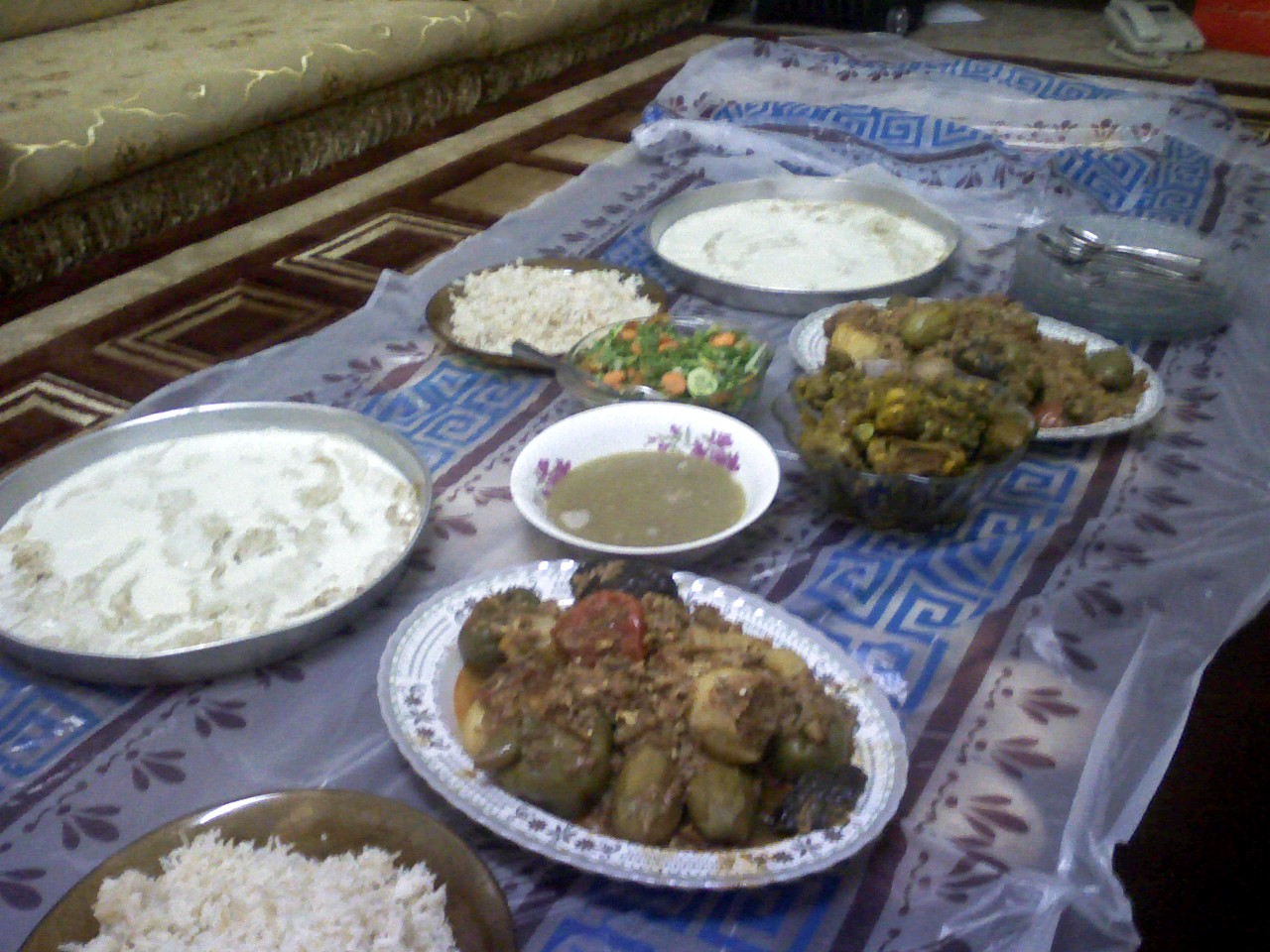 A traditional Yemeni feast |
What isn't so widely known is that Yemen is the birthplace of all Arabs and a very ancient civilisation with a long and illustrious history that stretches back thousands of years. The Prophet Noah had three sons with him on the ark that laid the foundations for all mankind with three distinct bloodlines; the inhabitants of Iran, Turkey, Saqlawiyah and Sind are the children of Yapheth, all inhabitants from the Arab world, which began in Yemen, are descended from Sam whilst all other dark skinned people are the children of Ham.
Yemen is also the poorest country in the Middle East with a culture that is very different from other Arab nations but uniquely, has preserved much of its rich architectural heritage. The capital Sana'a, where we would be staying, is not only one of the world's oldest continuously habited cities with a population of around 4 million but is also one of the highest capital cities at over 7,000 ft above sea level. Clearly, this was a place worth visiting.
As a country with few foreign visitors and even fewer tourists, it was always advisable to go with someone who knew the lay of the land so JD and I were accompanied once again by Hussain who was equally capable of handling awkward questions by Yemeni locals as he was arguing over the right way for Liverpool to win the league cup.
This was JD's second visit to Yemen in about ten years which meant deciding what to take was the big issue of the day. And so it was that JD spent the whole night packing and then was up early again for yet more packing. Our trip was a short one lasting just four days and with no intention of taking the kitchen sink, I finished packing in twenty minutes and spent the rest of the night playing Mario Kart DS instead.
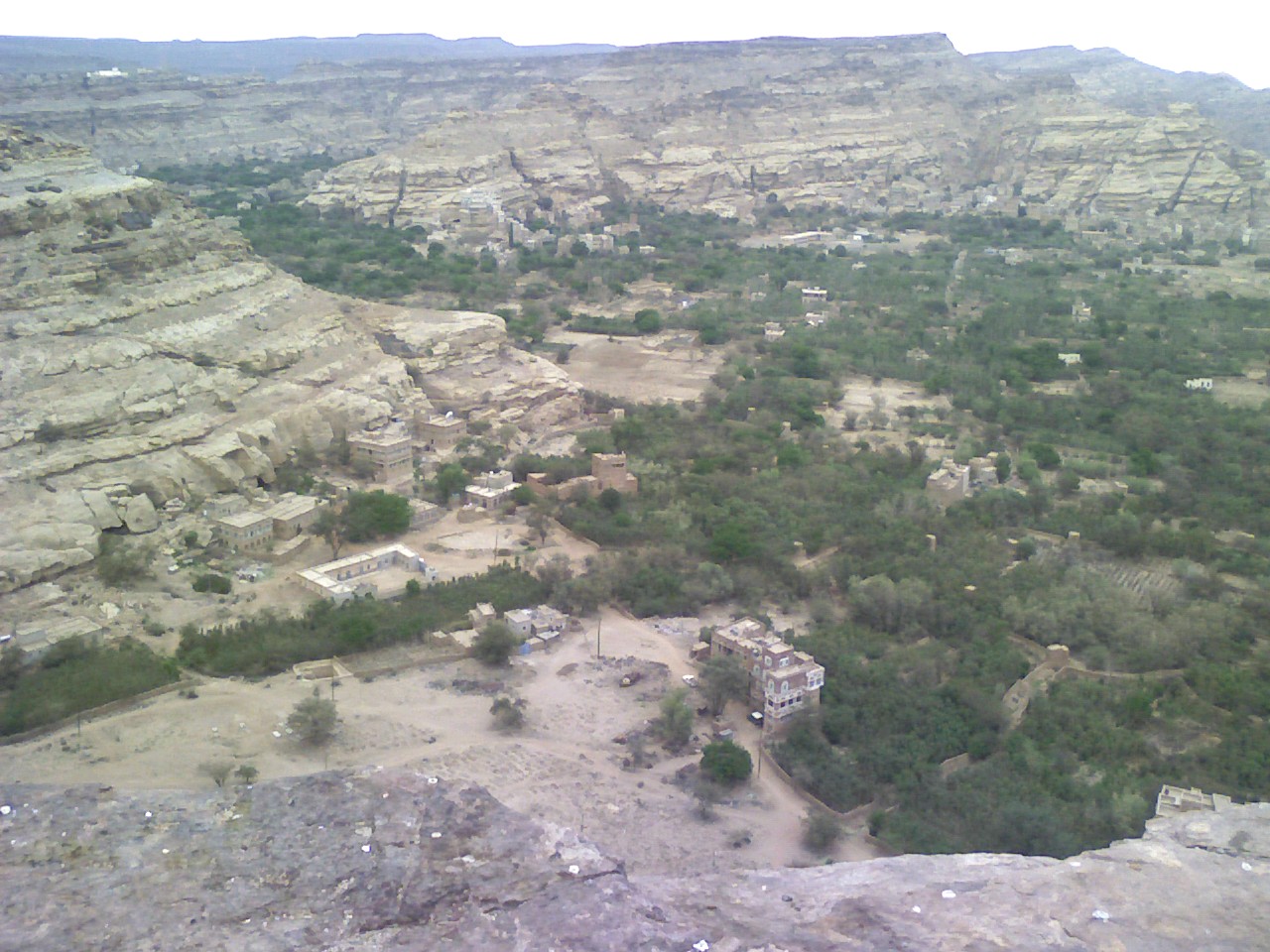 The picturesque valley of Wadi Dhahr |
A little light rain had fallen during the night followed by a sandstorm that left all the cars parked outside flecked with dirt. Matters weren't helped that Bahrain was still sandy and dusty in the morning with low visibility so everybody was driving cautiously, pretty much as though they were saving their tyres to pass on as an inheritance for the kids.
Bahrain International Airport was empty and our first task was to change money, dollars being the currency of choice in Yemen although we would also take a nominal amount of Yemeni Rials. We had purposely gone early to have a nosy around the duty free and whilst Hussain headed off to the smoking area, JD and I decided to grab a bite to eat first. Years ago, the only choice available would have been Jasmi's, a local fast food place that had all the appeal of acne on a first date. However, a McDonalds had recently opened up next door and so there was now fierce competition between the two and as a result, the fare on offer from Jasmi's had improved considerably.
Ignoring the McDonalds menu as a silent protest against globalisation, we ordered our meals from Jasmi's and tucked in. It was good junk food and even the toy that accompanied the meal was quite decent but inspecting the receipt, I noticed an extra charge for OJ which wasn't included as part of the meal. Technically, this meant I'd been robbed as I'd paid for burger, fries and drink but the OJ had been slapped on top of this. I marched up to the counter and demanded an explanation worthy of a scene from a Grisham courtroom cross examination. The girl was clueless yet apologetic so I let it be and stomped back to our table were JD had remained sitting wearing a look that said "I told you so".
  Video clip from the top and very edge Video clip from the top and very edgeof Wadi Dhahr showing the whole valley |
Time seemed to have zipped past and JD and I barely finished eating when the Al Jazeera flight started boarding. With Hussain still puffing away contentedly in the smoking area, we waited outside and had the ignominy of hearing our names being called by the flight crew over the tannoy as everyone else had boarded and they wanted to leave. Hussain ensured he finished his last cigarette without rushing and then strolled down to the departure gate as if he owned the plane and was finally ready to give the order for take off.
It was quite full on board, surprising given that Yemen wasn't a typical holiday destination, but JD told me that most of the passengers were Yemeni's returning home. Bahrain more than any other Gulf state had been handing out passports like they were going out of fashion resulting in a huge surge of people from Yemen, Jordan, Egypt and the Indian Subcontinent being granted citizenship with all the rights that entailed. Subsequently, the number of native Arab Bahraini's had dropped from 80% a few years ago to nearer 50% as the government re-engineered the social fabric of the country for its own political benefit.
The flight was just over 2 hours to Sana'a and I fell asleep almost as soon as the plane was airborne. I awoke just over an hour later to the endless deserts of Saudi Arabia below accompanied by the sound of Hussain and JD bickering. Eventually, big fluffy clouds floated into view obscuring the terrain and causing no end of alarm for JD who isn't the most comfortable of flyers.
The plane plunged into the sea of clouds as we began the descent to Sana'a and then just as suddenly emerged into a beautiful landscape with stunning views mixing dramatic swirls of brown, yellow and beige just like an oil painting. We had arrived in Yemen.
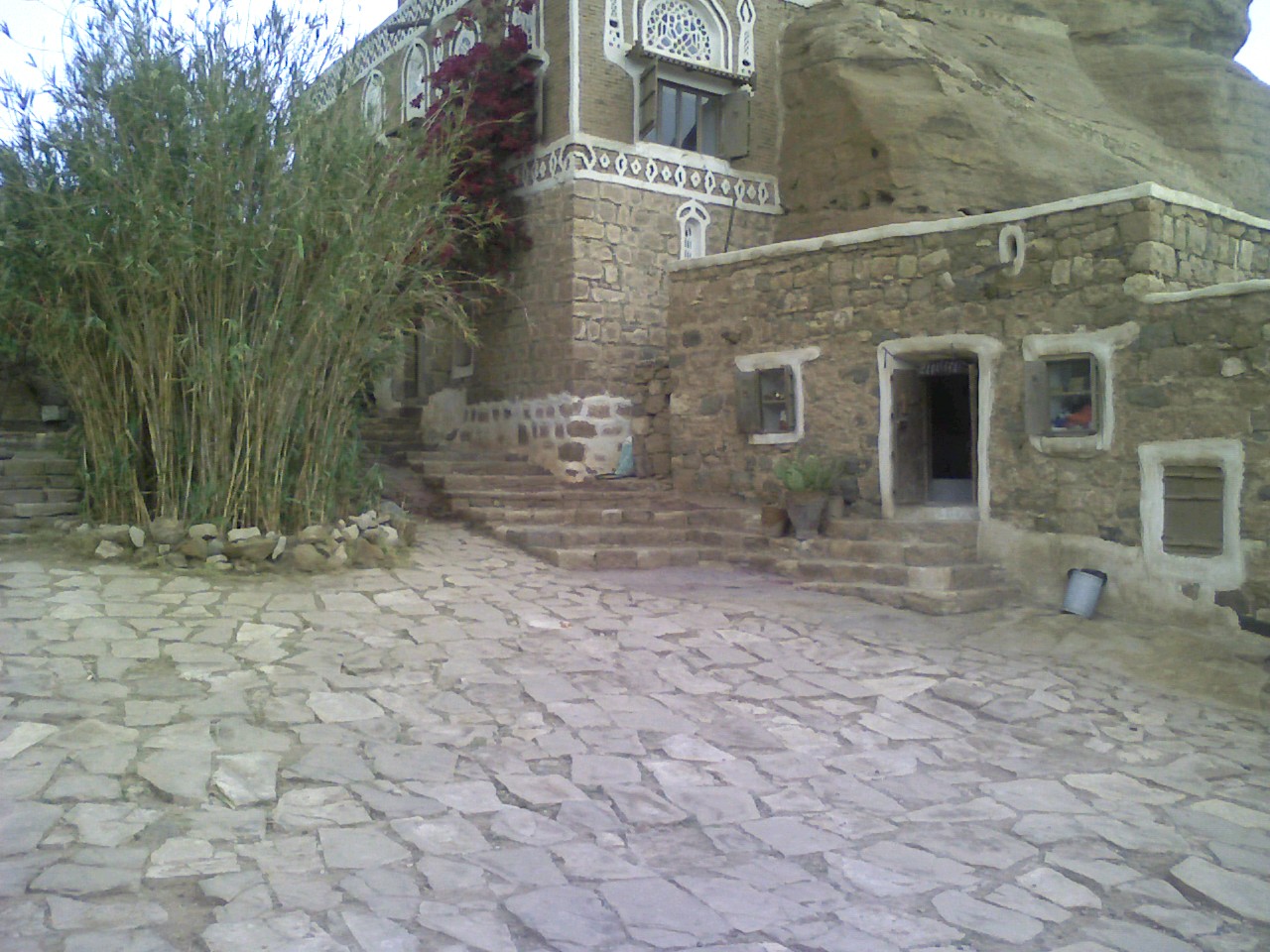 Courtyard with steps to the tower |
A sandstorm way off in the distance over the mountains reminded us that this was still a desert country but as we approached Sana'a, a patchwork of lush green fields began to scatter around the terrain. Yemen is known for agriculture and this was arable farming land just outside the capital. As we flew over the suburbs, I could see the capital was largely flat with no high rise buildings. There was little sense of urbanisation or dense population, surprising given how old Sana'a was. Everything appeared to be widely spaced and the few main roads that snaked towards Sana'a were largely traffic free.
We landed at 4pm in an airfield full of military choppers. There were no terminals and we waited by the plane in the warm breeze for the bus to come that would take us to the arrivals lounge. Yemen is a traditional country with ways and customs dating back hundreds of years so Hussain immediately took charge in dealing with the officials. My visa had already been prearranged for collection at the airport that took all of 5 minutes to secure followed by a few moments to fill in the relevant arrivals forms.
The terminal was small with just a few counters but there were plenty of guards and personnel, all of whom had guns which as always, made me uneasy. It wasn't busy by any means but security was very tight with both boarding passes and luggage tags checked along with passports. Duty free was a single long counter filled with expensive goods, most of which looked like dubious knock-offs. A lone soldier with a machine gun stood guard at the exit as we left the airport, 30 minutes after landing which was quicker than I expected.
It was a very agreeable climate outside; not overly hot but pleasantly mild with a cool wind and none of the humidity that is characteristic of most Middle East countries. We waited by a small patch of greenery in the car park for our hosts to arrive. A few minutes later, a minibus drove up and we greeted Abdul Hafeed and his wife Howida.
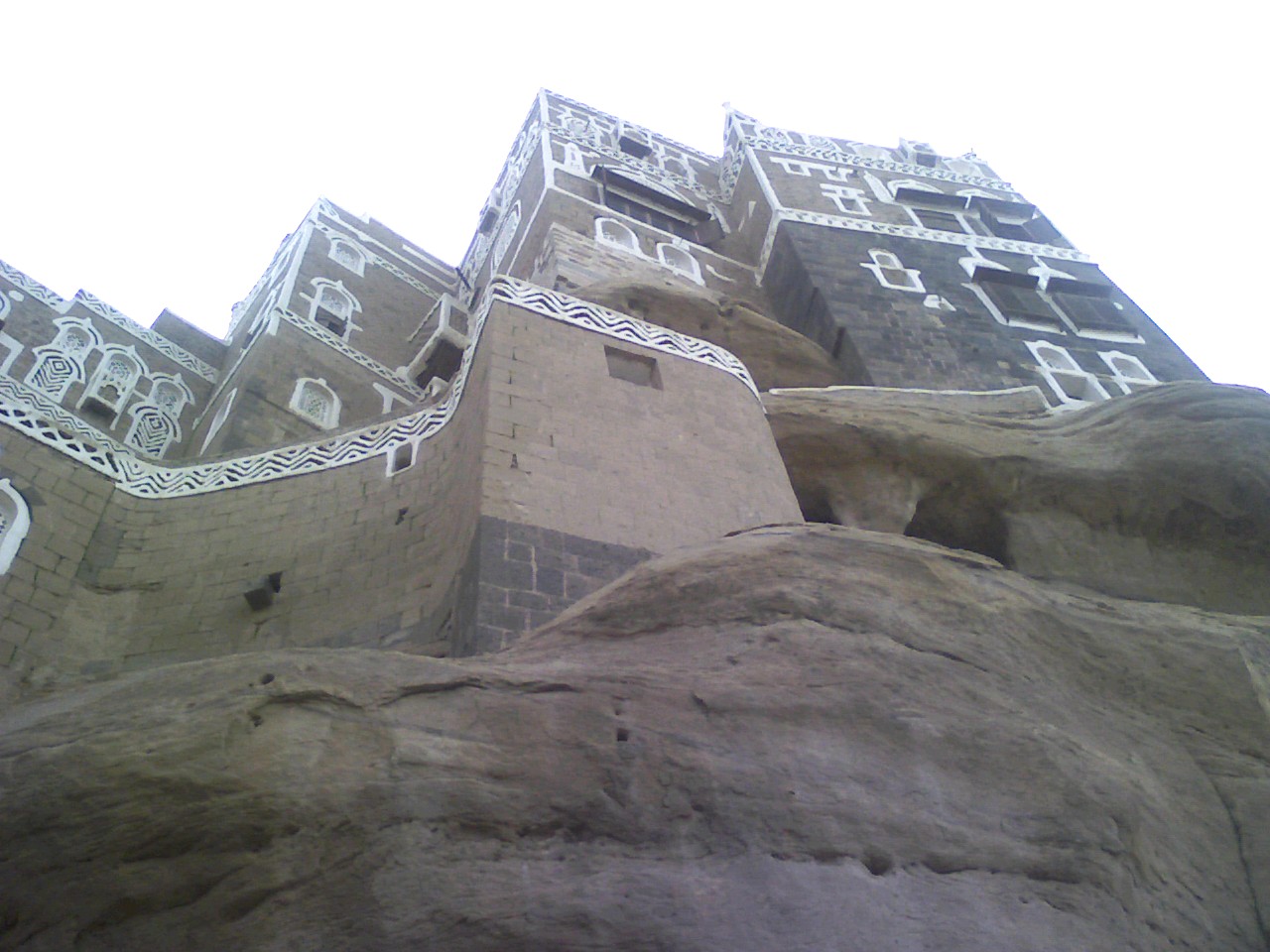 The towers of Al Hagar |
Abdul Hafeed was a quiet, softly spoken and very gracious mild mannered type of guy who would have made the perfect psychiatrist. He could tell a good story, was an expert at listening and had an interest in pretty much everything with a long list of fascinating facts on tap. He was neither prone to outbursts of high voltage chatter nor getting involved in a rowdy argument. As I didn't understand Arabic and Abdul Hafeed didn't speak English, both Hussain and JD acted as translators although we both quickly came to understand the gist of what the other was saying.
By contrast, Howida, a doctor who I'd met before in Bahrain, was feisty, spirited, excitable and made for tremendously lively company. She was a straightforward kind of person who had an opinion about everything and wouldn't think twice about saying exactly what was on her mind, something I'd always thought admirable. It was no surprise to see Howida leaning out of the window of the minibus and waving furiously before it'd even entered the car park.
Two of the kids had also come along for the ride and were just as excited as their mother to see us. Hala was the youngest and aged 11. She had a beautiful smile, snowy white complexion and was not only sweet and quiet but also very smart. Her very energetic and lively older brother by one year was Ahmed who immediately leapt out of the back of the minibus and hugged us all before rushing off to get the bags. The relationship between older brother and younger sister was amicable and reminded me very much of that between Bart and Lisa Simpson. One thing I found hilarious yet utterly delightful was that Hala would often chime in during a conversation to correct her older brother whether it was fact, fiction or just plain old Arabic and English grammar and vocabulary. As I said, she was very smart!
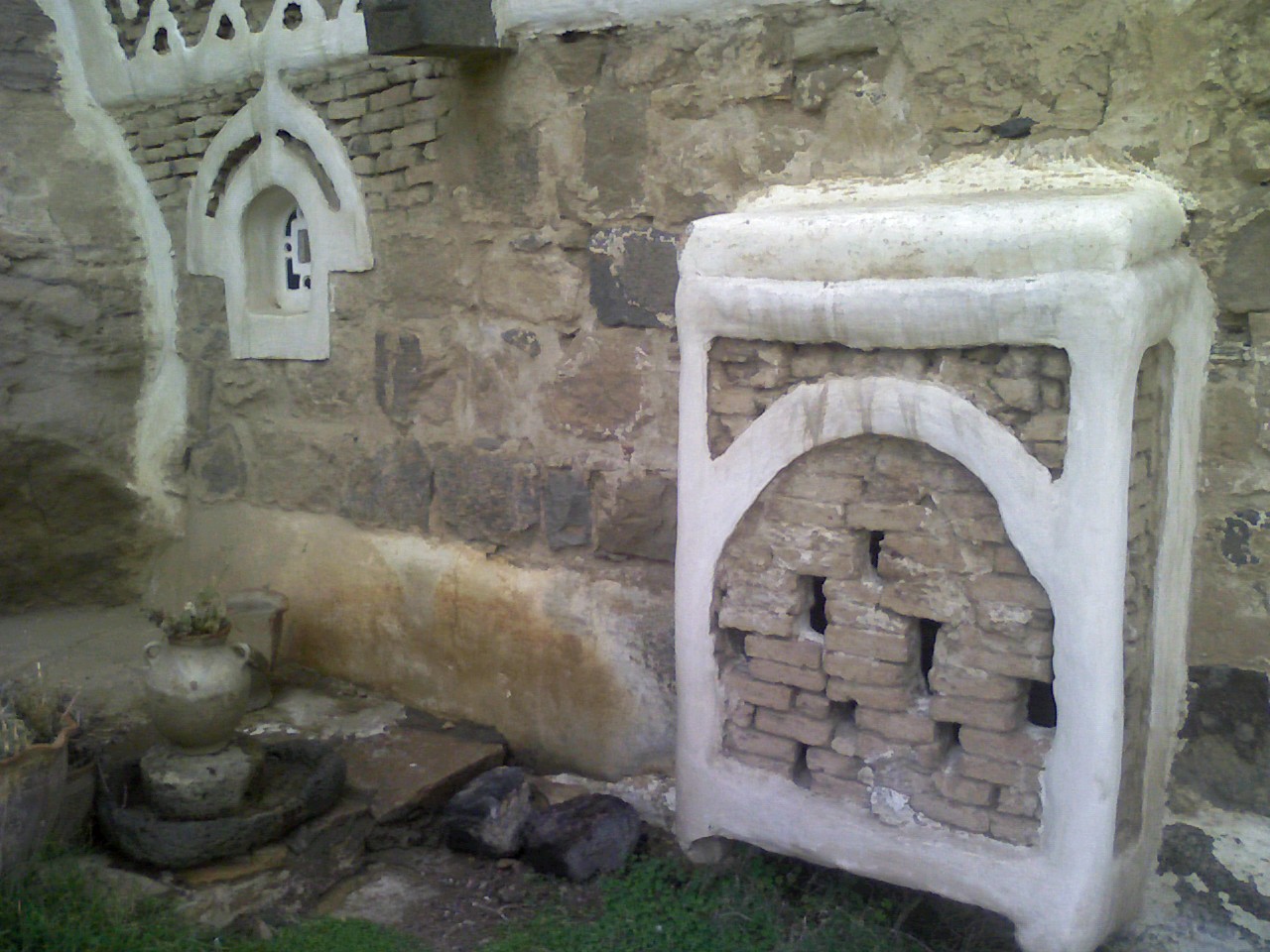 Cooling holes to keep bottles cold |
The minibus was a bit of a squeeze but we all piled in with Hussain and I riding shotgun in the front seat, my arm hanging out of the window because there was nowhere else to put it. Almost immediately upon leaving the airport car park we passed one of the most well known areas of Sana'a, a place called Al Rawdah that, like much of Yemen, had a story behind it. Abdul Hafeed wasted no time in relating the tale on our journey to the hotel.
During the 7th century when the Umayyad dynasty ruled, there was a woman called Rawdah who lived in the area we now passed. She loved a very good looking guy called Wadha but their respective families did not want them to marry due to tribal differences. The girl's parents complained to the prospective groom's family that Wadha being in love with Rawdah was causing problems and so the couple were kept apart. Rawdah was heartbroken and became ill, dying soon afterwards. With the girl that he loved gone for ever, Wadha subsequently left Yemen for Syria.
The Caliph at the time was Abdul Al Malik bin Marwan, a homosexual, who heard of Wadha and sent for the man to live with him in his palace in Damascus. As Wadha was so handsome and beautiful, the Caliph covered his face so that no other would see him and he could keep Wadha for himself. The story goes that the Caliph's wife curious of what Wadha looked like took him into the bedroom as she herself wanted him. Night fell and the Caliph came to the bedroom but his wife who heard him approaching took Wadha and hid him in a small trunk. Once the Caliph left in the morning, his wife opened the trunk only to find Wadha dead having been squashed there all night with no air, food or water.
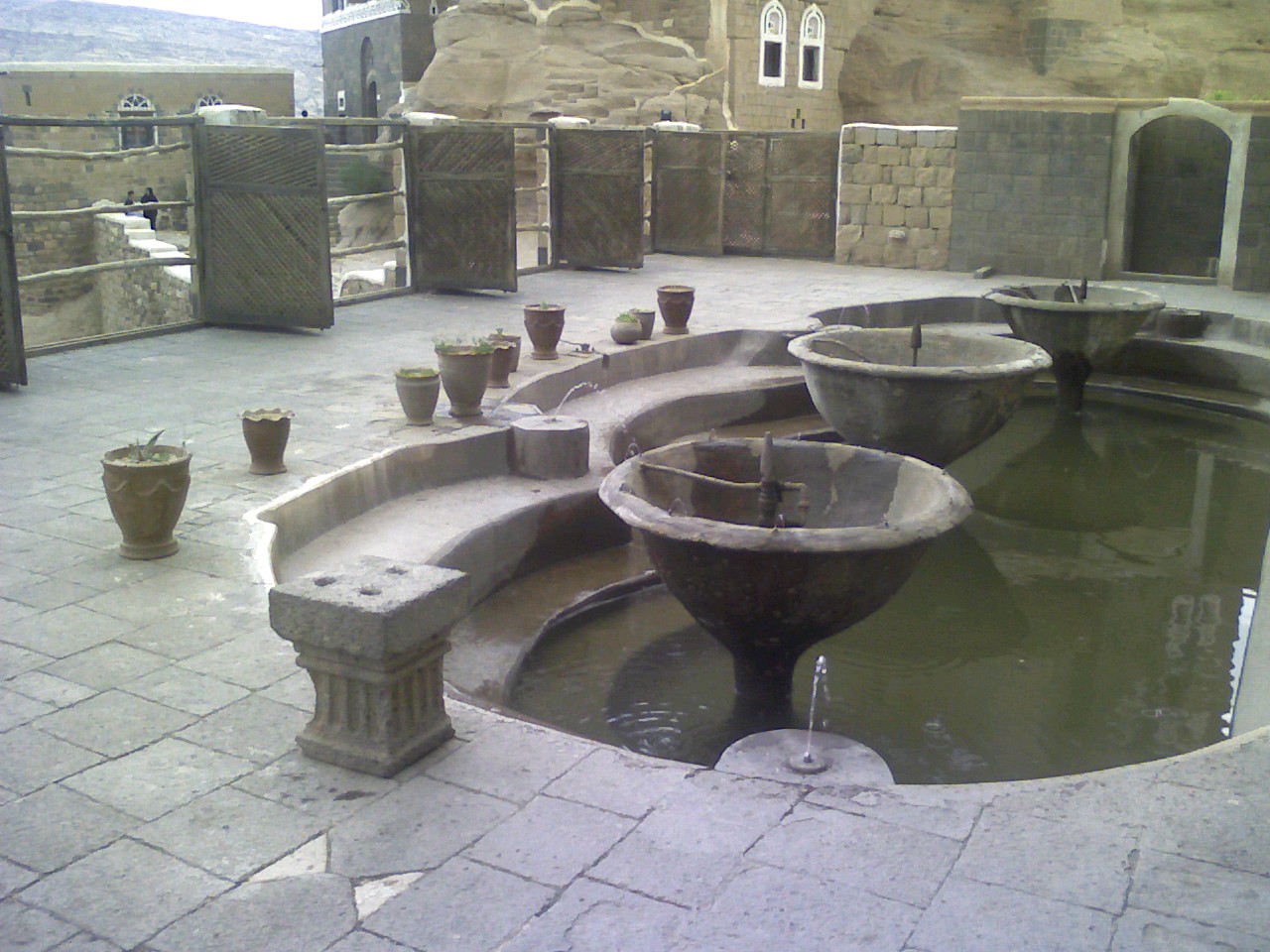 The gardens and fountains of Al Hagar that look out across the valley |
As the minibus approached the centre of Sana's, we passed a huge enclosed area that looked like a massive fortress. This belonged to Sheikh Naji al-Shaif who is head of the Bakeel tribe and had 6 million Yemeni followers. It was the guards of Sheikh Naji who shot Sheikh Hassan Makki, the then Minister for Foreign Affairs, but didn't kill him. Each of these tribal sheikhs had their own armies, artillery, weapons and full autonomy from the government.
Up ahead, the road had been closed for repairs and some kids were playing football on the main street which was littered with rubble. As with virtually everywhere in the Gulf, roads had a central reservation so that U-turns were only possible at designated junctions. We drove half a mile all the way down to the road block, avoiding the excited kids who had no intention of moving, and then drove all the way back up again. This part of Sana'a was the poorer area which was clearly evident all around. Shabby buildings lined the streets whilst residents peered out from darkened rooms that had no doors or windows. A few kids played barefoot in the streets and debris was strewn everywhere.
Eventually, we came to an aqueduct called Al Saela which is Arabic for "where the water comes flowing" and drove down it joining the other traffic that had begun to increase as schools and shops closed for the day. Abdul Hafeed told us the aqueduct was used in the winter months to carry water from the mountains to Ma'reb, a dam built thousands of years ago by the Sa'ba civilization during the time of the Prophet Suleman. The Sa'ba civilization was so called because of the founding leader, Abd al Shamse Sa'ba, who started the colonisation of this area. The word shamse is Arabic for sun and al Saba and his followers were named as such because they were sun worshippers.
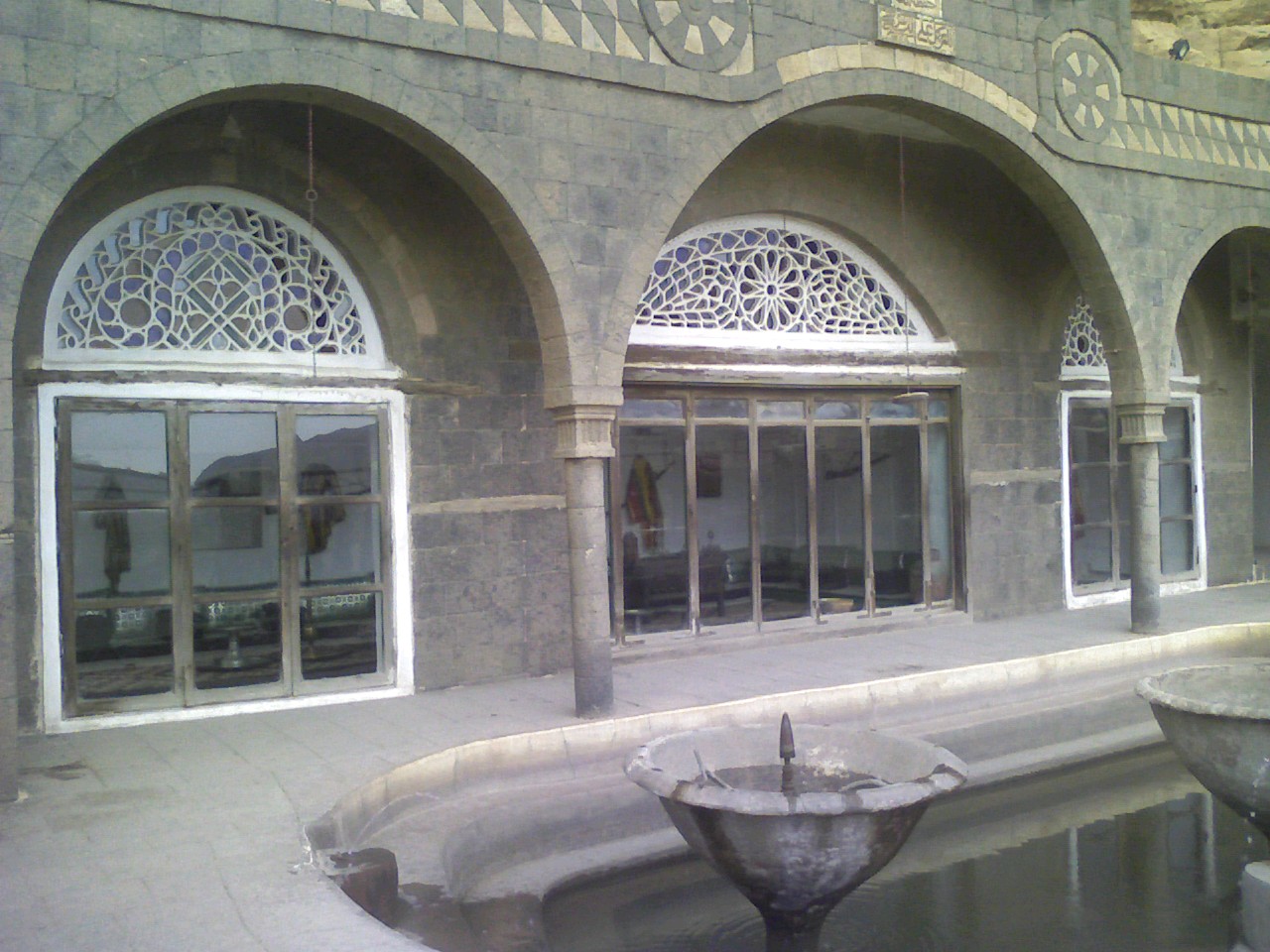 The qat rooms of the ruler and his wives |
The aqueduct had been built in the 1980's and specifically designed to ensure water was carried away from the famous salt market and old part of the city. This part of Sana'a is a protected world heritage site and rich in architecture and history. It looked like nothing I'd seen before in the Gulf where everything was always being continually being rebuilt because of the ravages of sand and extreme heat. However, here in the old part of the city, houses could not be erected unless they complied with strict regulations.
Each house was tall and narrow with several floors from the ground up. The topmost room in each house is called the tairamana where qat is taken with guests. Qat, as we soon discovered, was a large and very important part of Yemeni society. Wherever you looked, you would nearly always see somebody chewing on the qat plant leaves, each of which had different properties and tastes. The effects of chewing the leafs varied depending upon the particular pharmaceutical attributes of the plant from which it was taken but all forms of qat provided a mild stimulus in various degrees of intensity.
The traffic had gotten quite heavy now and there was a constant blare of horns but nobody drove fast in Yemen so it didn't feel at all dangerous, another welcome difference from the rest of the Middle East that seemed to think that the quicker you drove, the less likelihood there was of causing an accident.
 The kitchen and maid quarters |
JD and I were staying in the Sheba hotel directly opposite the Central Bank. This was an independent five star place that our hosts in Yemen had kindly booked for us to ensure we got a local deal rather than the tourist rate. Given the recent political events in the Gulf, security was very tight around here with guards, heavy steel gates and rising road blocks all around the hotel although a large part of this was also because of its close proximity to the Central Bank.
Any entry to the hotel required passing through an airport style scanner regardless of whether you were a visitor or a guest and this was constantly manned. Beyond lay the hotel lobby that was smart, modern, hugely spacious and very impressive. A small cafe to one side offered a tempting array of posh looking cakes whilst the obligatory foreign exchange counter was tucked away discretely in a corner. The counter staff spoke perfect English, Arabic, Urdu and most probably a smattering of other languages that might be expected from visitors to this part of the world.
 Video clip of the valley from Al Hagar Video clip of the valley from Al Hagar
|
There were quite a few Westerners there for business meetings, surprising given the current state of Yemen. Looking around, you'd have been forgiven that this was just another smart five star hotel in any part of the world and indeed, the lobby alone was a fair bit better than quite a few others I'd visited in the Gulf. I had no idea how Yemen was doing economy wise however the bustling lobby of the Sheba certainly projected an image of optimistic growth.
The hotel was divided into an older section and a newer section that had recently been renovated. We checked in and discovered the local deal had relegated us to the old part of the hotel that was very worn and dated. JD was having none of this though and persuaded the manager to move us to the newer section that was much better. Our rooms were clean and comfortable but very small for a five star hotel with barely enough space for two people to pass. The view from my room overlooked a highway that ran between the hotel and Central Bank but there was barely any noise from the traffic outside.
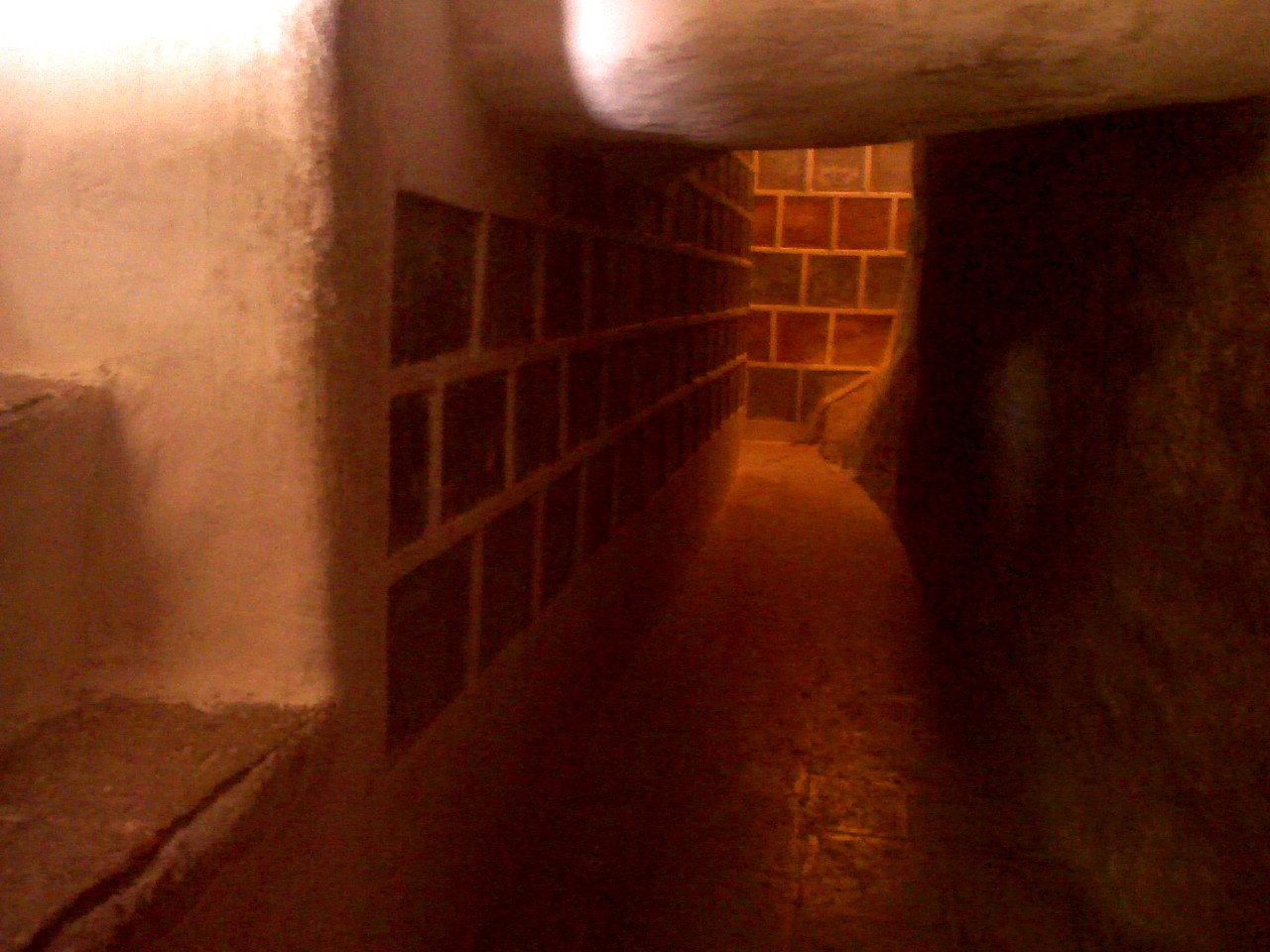 A secret passage in the fortress |
Abdul Hafeed had dropped us at the hotel and was to return an hour later after we'd freshened up so we hurriedly unpacked, washed and got ourselves in order as we'd be going to Howida's house that evening for dinner. It was getting dark outside by the time we set off but there was still plenty to see; officials stood in the middle of the road directing traffic at busy intersections, bustling street stalls with weird and wonderful looking fruits and a huge qat market that seemed to be organised along the lines of an investment bank trading floor.
Nearly all the men wore the traditional sarong-like Yemeni dress with open toed sandals and a ceremonial curved dagger tucked into the belt and I noticed that whilst each dress was similar, the daggers came in all shapes and sizes. However, one thing that was common among all the men was a mouthful of qat with plenty of Yemeni's looking as though they were hiding a few other things in there too such was the size of the bulge on their cheek.
The drive to Howida's was short and we suddenly turned off the main road into a side street to park up. Although we were still in Sana'a and quite central, it felt like more like being in the suburbs with no crowds of shoppers or constant blaring of horns and visibly less traffic. Howida's place was at the top of an apartment block that had three floors with no lifts and just a narrow, dark and surprisingly steep staircase accessed from a side entrance.
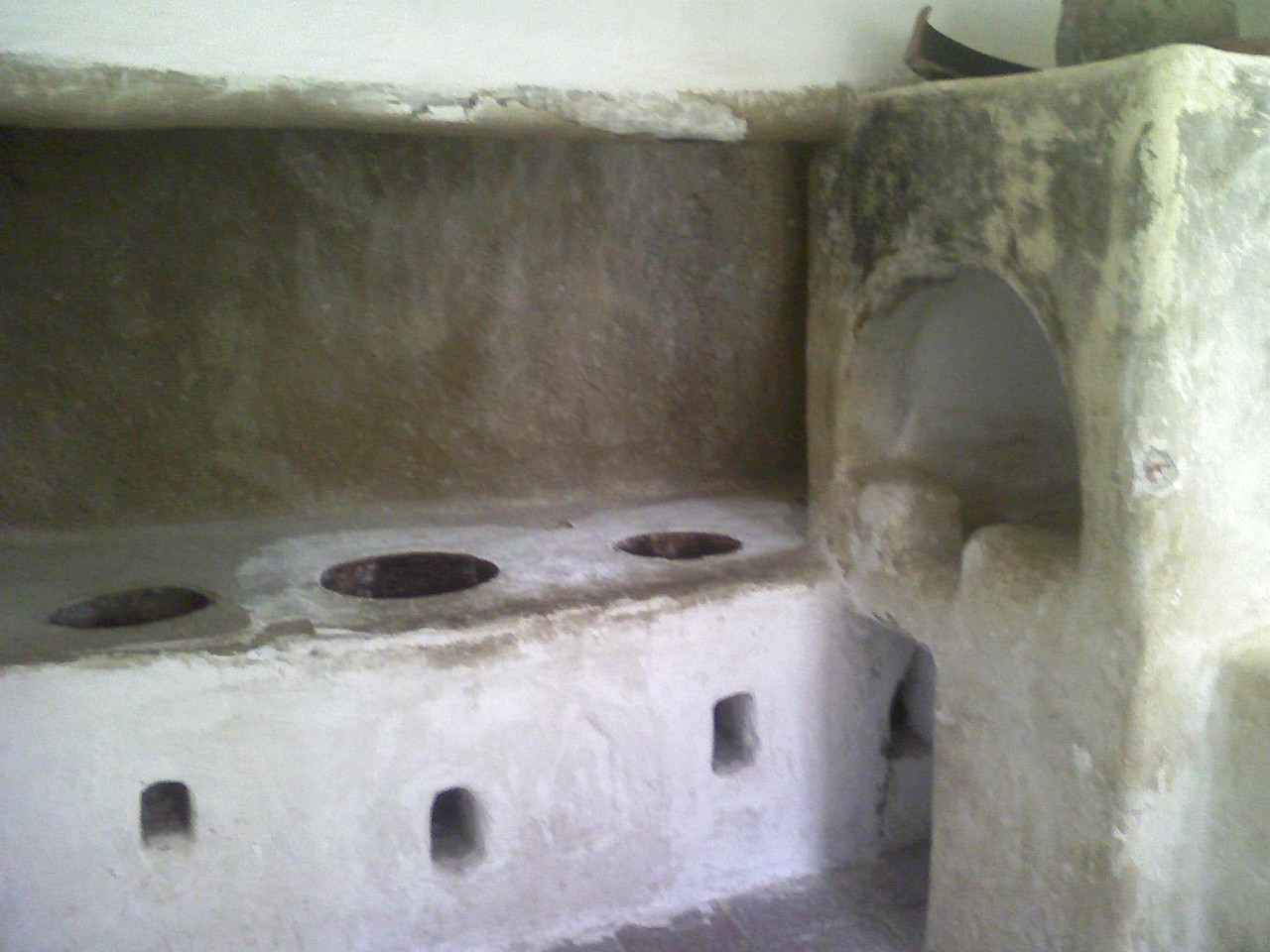 Kitchen with stoves used for cooking |
We climbed the stairs single file and immediately everyone started puffing which reminded me again of just high Sana'a was at over 7,000 ft above sea level. Of course, Ahmed having lived here all his life had no problems with the climate and bounded up the stairs ahead of everyone else to open the door. Howida was waiting to greet us at the top and we removed our shoes, as the custom in the Gulf, and stepped into the lounge. It was furnished simply yet comfortably with large soft cushions on the floor to sit on and a TV and a small side table at one end together with a bookcase that had various pictures of the kids. There was very little clutter and a single large window offered a view of the city although it was too dark by now to see anything.
Howida's eldest daughter Zainab came to greet us. She was 18 and not only looked very much like Abdul Hafeed but had a very similar personality too. Side by side, it was fairly obvious they were father and daughter and like Abdul Hafeed, Zainab was quiet by nature and not prone to bursts of excited chatter.
Our gracious hosts sat us down and spread a sufra, a kind of plastic table covering popular in the Gulf, on the floor so that dinner could be served. The dishes all looked wonderfully tempting and I was keen to try a bit of everything as Yemeni food is quite different to more traditional Middle Eastern fare.
The appetiser was shafoot, a savoury starter of baked lahoah cornbread eaten with a yoghurt mix of spices, mint and coriander. Lahoah is the Arabic word for obligatory which is why this particular appetiser was so called as the tradition is to always start a meal with cornbread.
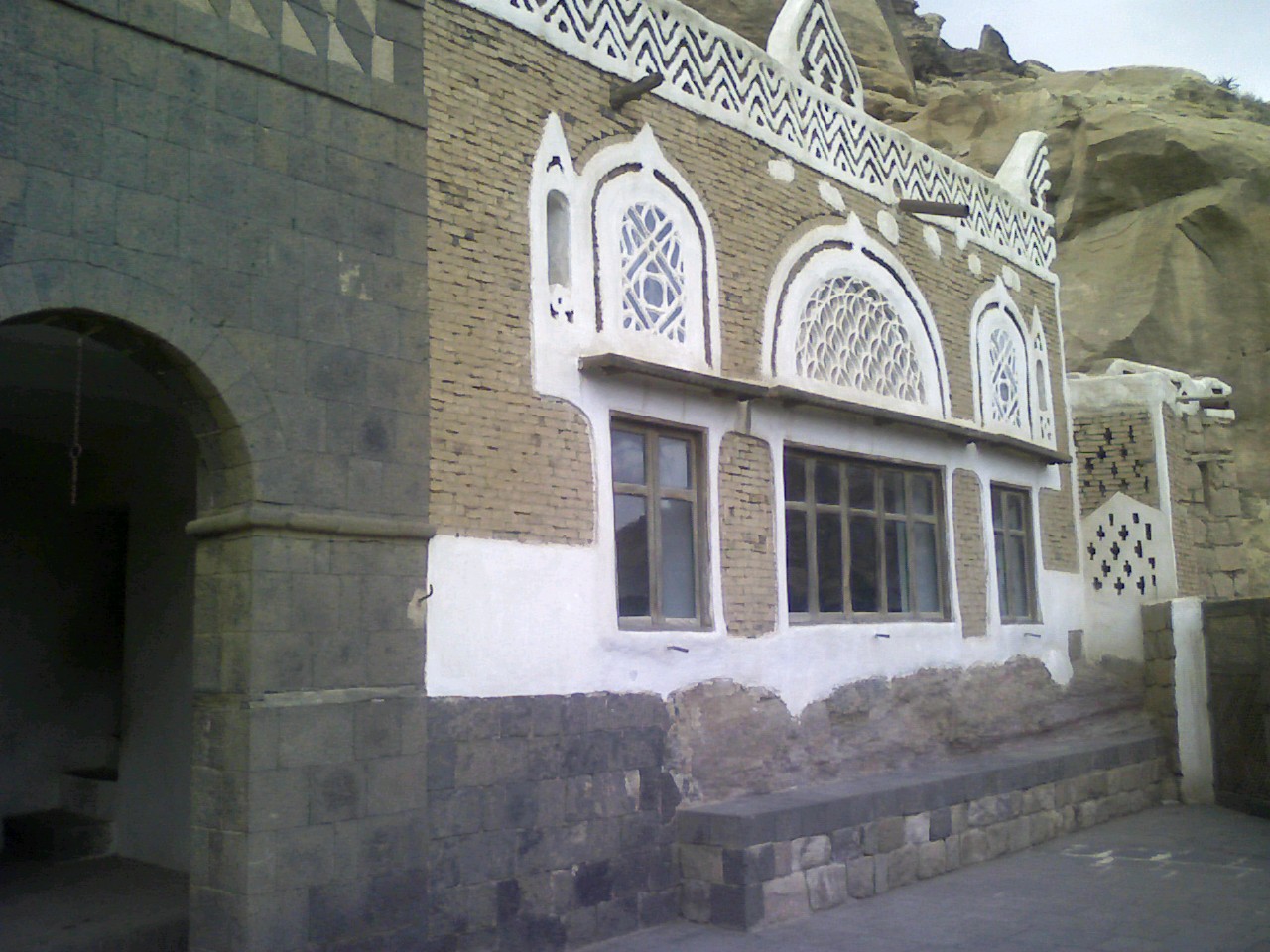
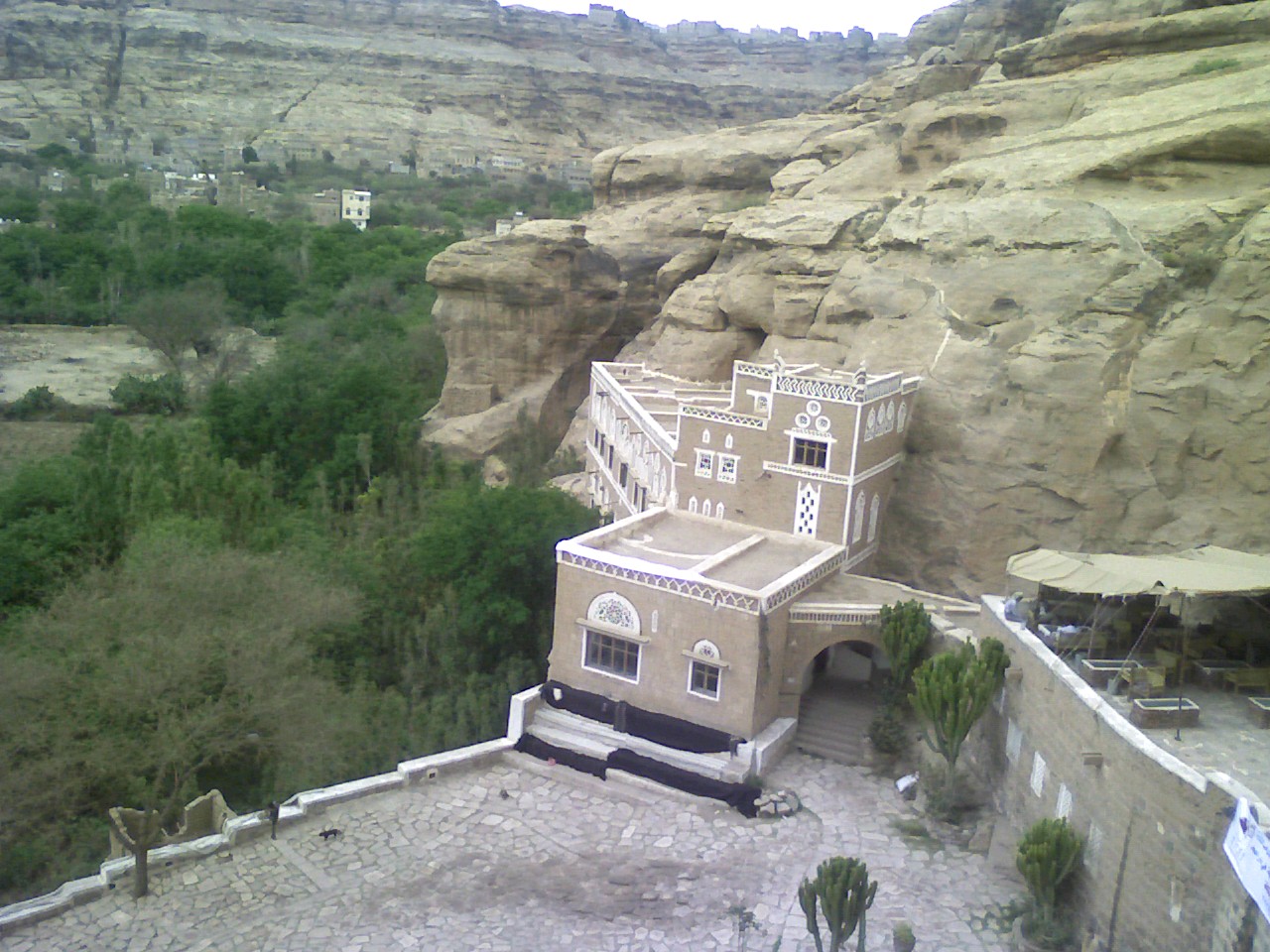 A traditional Yemeni building in Al Hagar |
The rice had been fried and then boiled with other uncooked rice Yemeni style for a dish that had a different texture and taste to what I had previously tried in the Gulf. Accompanying this were very tender cuts of lamb cooked with saffron and with the meat stock served in a separate dish to seal in the flavour of the spices. However, it was the vegetables that I found the most interesting part of our meal. The dish was called mahshe and consisted of stuffed kusa (courgettes) filled with rice and mincemeat served with potatoes and tomatoes. This was very tasty indeed and I don't even like courgettes!
Finally, there was bint al sahen, a kind of flatbread made with layers of rolled flour and baking powder served with Yemeni honey and spices. Bint al sahen roughly translates as daughter of the plate and was so called as the tradition for a prospective bride is to prepare this dish for her in-laws as a test of her cooking skills. Although it was served with the main dinner, I found bint al sahen more suited as a dessert where the sweet honey and the lightness of the bread made the perfect end to a lovely meal.
With dinner over, everyone leaned back contentedly on their cushions for tea and, for our hosts, qat. I asked Abdul Hafeed about the Yemeni dress I had seen earlier and he immediately got up to put on his robes to show us. Apologising profusely and not wanting to cause any fuss, I pleaded with Abdul Hafeed not to go to any trouble but with typical generosity and graciousness, he insisted on putting everything on. And mighty fine he looked too in a crisp and smart pristine white dress with a very ornate dagger tucked into the belt.
 Video clip of one of the many rooms Video clip of one of the many roomsshowing pictures of Yemeni rulers |
The whole outfit is called aseep and the traditional curved dagger was the ghambia. The hilt of each ghambia was often decorated according to the family name and served as a method of identification as well as a mark of social class and seniority. Abdul Hafeed told us about the fascinating set of protocols around the whole wearing of the ghambia that after all, was still a dangerous weapon. Apparently, drawing a ghambia in public had far reaching connotations and was quite a serious affair that required mediation by the police or tribal chiefs. Hence, if two Yemeni's drew their ghambia's, it indicated they meant business over some kind of serious dispute which would then need to be referred to the authorities for resolution. Anybody could also complain about having seen a ghambia drawn in public which would warrant an investigation by the same bodies.
Ahmed had a Sony games console that he wanted to show me but with no spare electrical sockets, I offered to go buy an extension lead from the local shops around the corner. Ahmed thought this was a splendid idea and leapt up enthusiastically to put on his shoes before I had even finished my cup of tea.
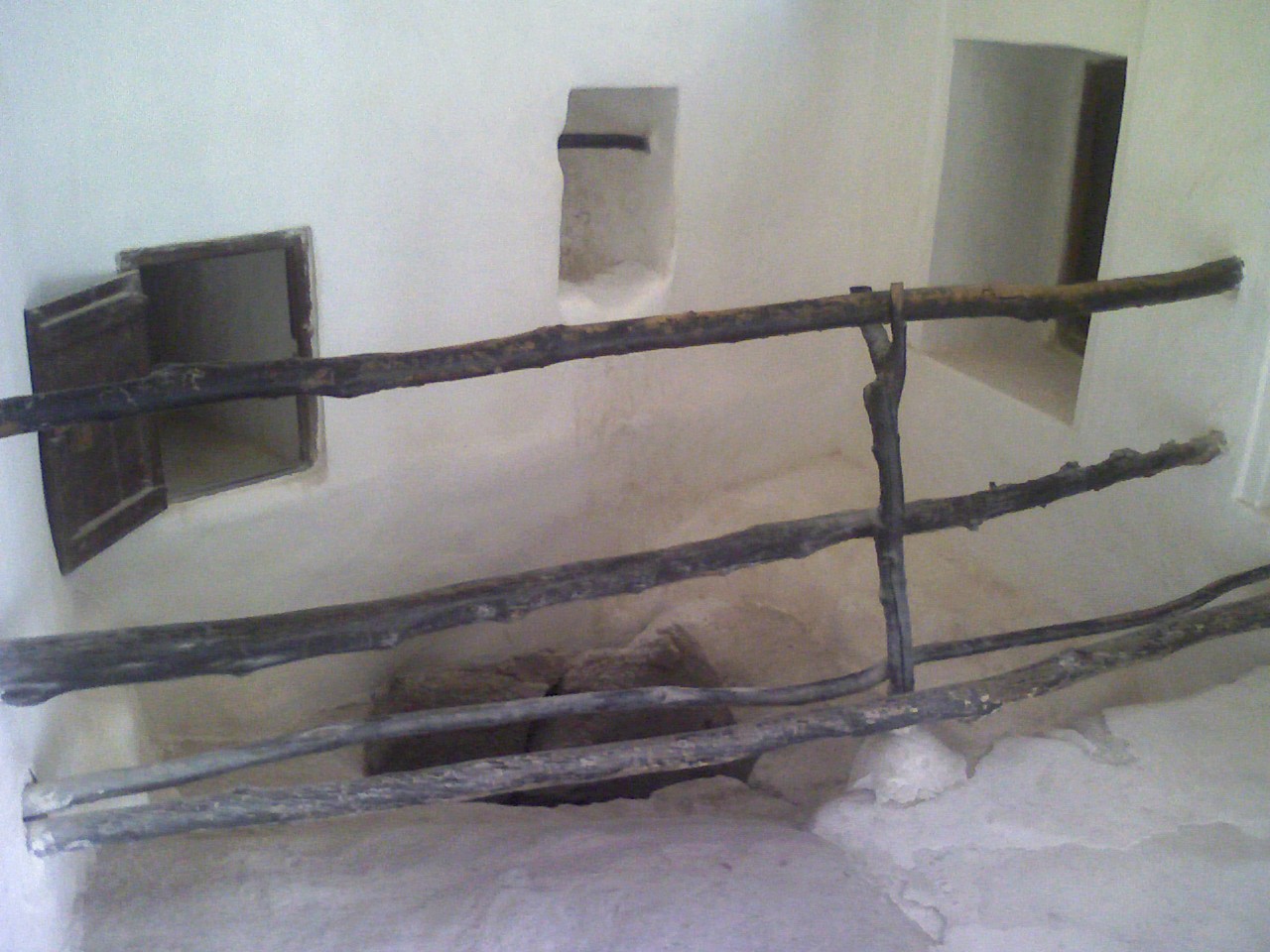 The wells were used in case the fortress was under seige during war |
This was my first proper wander around Yemen and we strolled up the main road to the electrical shop passing various garages, general stores and clothes shop. That is to say I strolled whereas Ahmed skipped, hopped and generally wasted no time in jumping around like an excited puppy. It wasn't busy at all but I got a couple of curious stares from the few people milling around outside that I didn't mind at. Dressed the way I was in jeans and t-shirt and wearing shoes and socks, I suppose it was obvious I was a visitor.
Like most of the Gulf, businesses generally stayed open till late and we eventually reached the electrical store that seemed to be very popular with the locals. I had no idea if the owner spoke English so I let Ahmed do all the talking and we inspected a few extension leads before plumping for one that had enough sockets and didn't look like it had been made of melted plastic. I was just about to hand over the money when Ahmed started bargaining like an Egyptian carpet dealer. For a 12 year old, he certainly knew how to handle himself and we left with a modest discount on the ticket price.
Back at Howida's, we stayed until well past midnight, enjoying the chatter and conversation which was in full flow with Howida at the helm. She had a truly infectious laugh that was halfway between a snicker and a mischievous giggle you might hear after a particularly funny prank. It was utterly hilarious and I couldn't help but chuckle every time Howida laughed.
Eventually though, it was time to leave and Abdul Hafeed got up to drop us back at the hotel. Stepping outside, I was amazed to see the streets completely empty and even more surprised at the pin drop silence. I had never seen this before anywhere in the Middle East, it really did feel as though everyone had actually gone to bed. There was no traffic, no open shops, no hum of air conditioners, not even the distant rumble of the highway or a solitary figure wandering around.
We clambered into the minibus and set off along the empty streets. Again, we encountered virtually no other cars or people and the whole of Sana'a appeared deserted. We were back the hotel in no time at all which had now lifted the heavy crash barriers outside for the night shift. Going through the metal detectors, JD and I retired to our rooms where I crashed out almost immediately.
Sunday 28 March 2010
Everyone was up by 9am and we ate at 10. I find the mark of any good hotel breakfast comes down to just two things; how well the eggs are cooked and how fresh the doughnuts are. For the latter, the Sheba passed with flying colours and the eggs weren't too bad either. My two egg cheese omelette was surprisingly small and looked more like a patty but it tasted just fine. There was also a good assortment of fresh fruit juices to try, not too sweet (that was the job of the doughnut) but not too sour or acidic either.
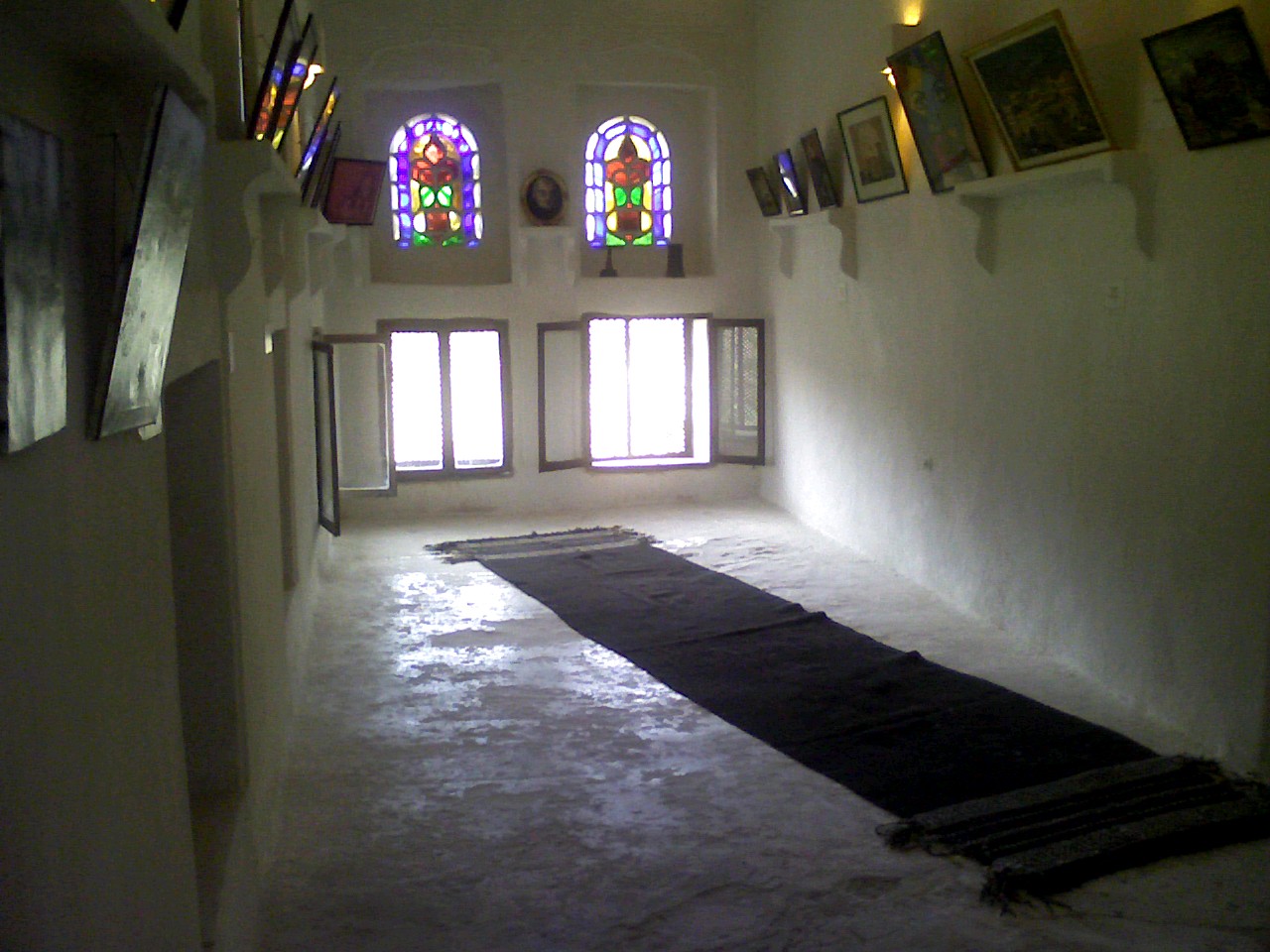 The long and narrow children's room at the top of Al Hagar |
Breakfast done, JD and I dressed and waited downstairs in the lobby for Abdul Hafeed who was due to pick us up at 11am. In the event though, he called ahead to say he'd been delayed because of the traffic and with me being seated in a big comfy chair, the quiet hum of the hotel lobby eventually lulled me to sleep. In no time at all, I had nodded off much to the amusement of JD who decided to take a picture of me with my mouth open.
By midday, we were back in the minibus with everyone and heading along the Zubairy Road which splits Sana'a in two. We passed by the Balaga gate, old Sana'a having seven gates, and through an area called Al Ghaa which is the Arabic word for bottom. Here was the Jewish area of Sana'a and the houses each had a kammariyah which is the decoration above the windows where the star of David is placed. At one time, Sana'a had a large Jewish population numbering in the thousands but few remained today although they did enjoy the protection of the government. Yemen was a largely tolerate place with any divisions made largely along political rather than religious lines.
Zubairy Road was built circa 1962 after the revolution and goes past Kabr al Seeny which means "graveyard of the Chinese". This was so called because a lot of Chinese workers died and were buried here when the mountain was cut to build the road that became the first in Sana'a to connect the capital with a place called Hudayda. Abdul Hafeed told us that lots of countries donate to Yemen for various projects. Qatar for example had built the Ministry of Foreign Affairs and the main library whilst Libya had donated around 100 residential buildings, each with 8 flats. On a more sinister level, Saudi Arabia, with whom Yemen shared a border, donated a hospital which was known to locals for harvesting body parts under the excuse of necessary major surgery for minor ailments.
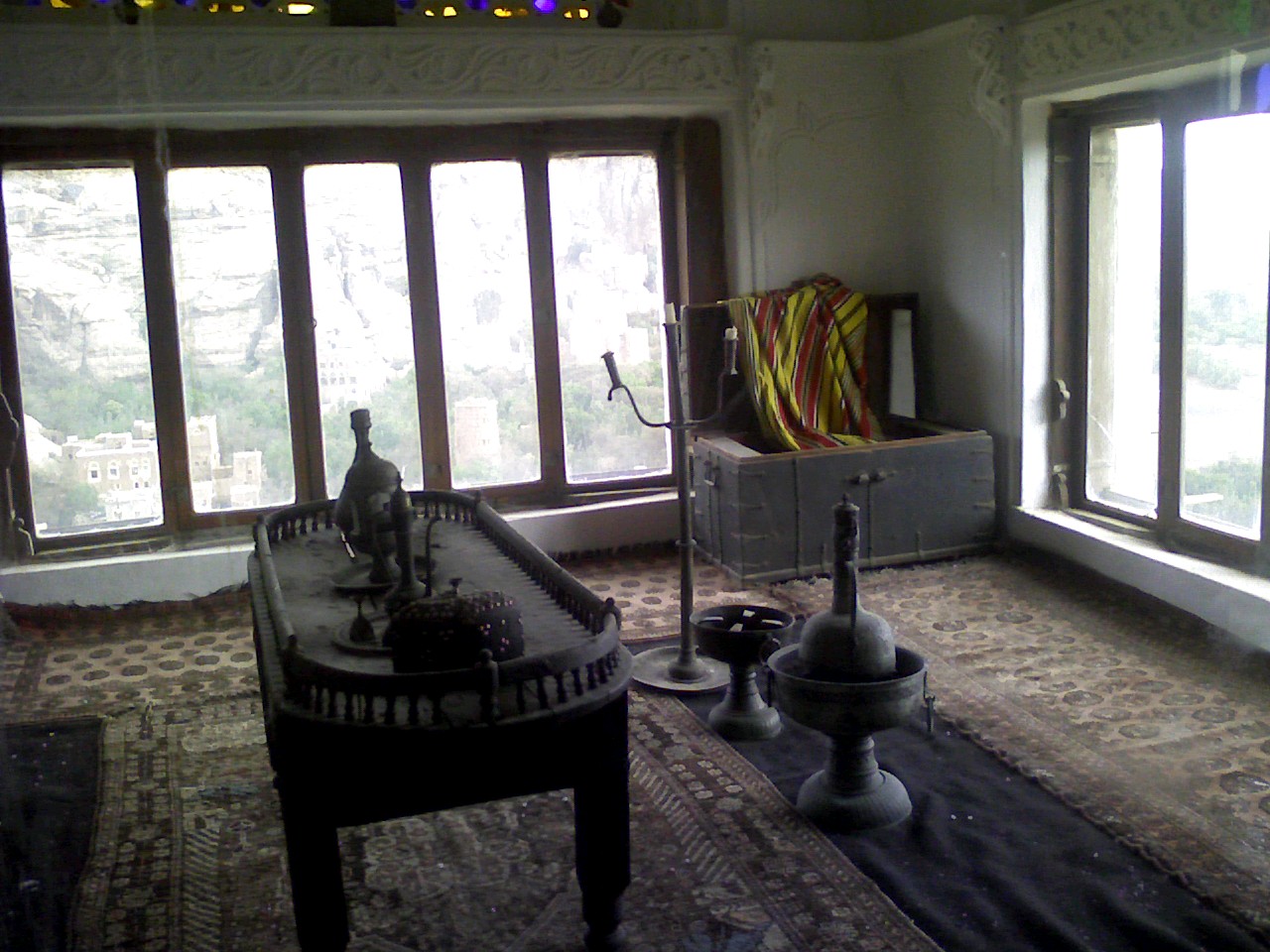 The ruler's room at the top of Al Hagar |
We passed by Madbha, the most densely populated area of Sana'a and then a place called Hajah. It was here that Islam was introduced to Yemen as the first populated area that was conquered by Imam Ali. Driving on through Hajah, we eventually reached a very bumpy and rocky strewn road in a place called Wadi Dhahr that was our destination. Parking up, we got out of the car and went on foot for a very good reason as the ground beneath us suddenly fell away into a sheer drop as we approached a magnificent valley that offered a stunning vista.
Wadi means valley whilst dhahr means back and this place was called Wadi Dhahr because it was like standing on the back or shoulder of the surrounding hills. We could see the other side of the valley and here and there were dotted small turrets whilst below us lay a few villages and a fortress where the ruler of Yemen used to reside. Far off into the distance where the valley parted were snow-capped mountains and a breathtaking landscape of outstanding beauty.
Ignoring the protests of JD who didn't have a head for heights, I shuffled towards the edge of the cliff and cautiously peered over. The layers of rubble that made up the cliff were fully exposed here and one was almost tempted to just descend down the side using the rocks as a kind of simple stairway. There were no safety barriers, fences or any other kind of equipment that would have been useful had anyone fallen over the side and the whole place was deserted save for a few excited kids who had come to check out the visitors.
A kind of bandstand stood some distance away on the edge of the cliff. It had a bench where people could sit and enjoy the view and we saw a young couple here as it was a popular and private spot for prospective partners and newlyweds to visit given that it was out in the sticks. After the couple had strolled off, I went over to sit down and enjoy the peace and tranquility. As with the night before, the thing that immediately struck me was how quiet it was, you could have dropped a pin over the cliff edge and hear it drop onto the rocks. In fact, it was so quiet that we actually caught the low murmur of voices coming from the village far down in the valley below us.
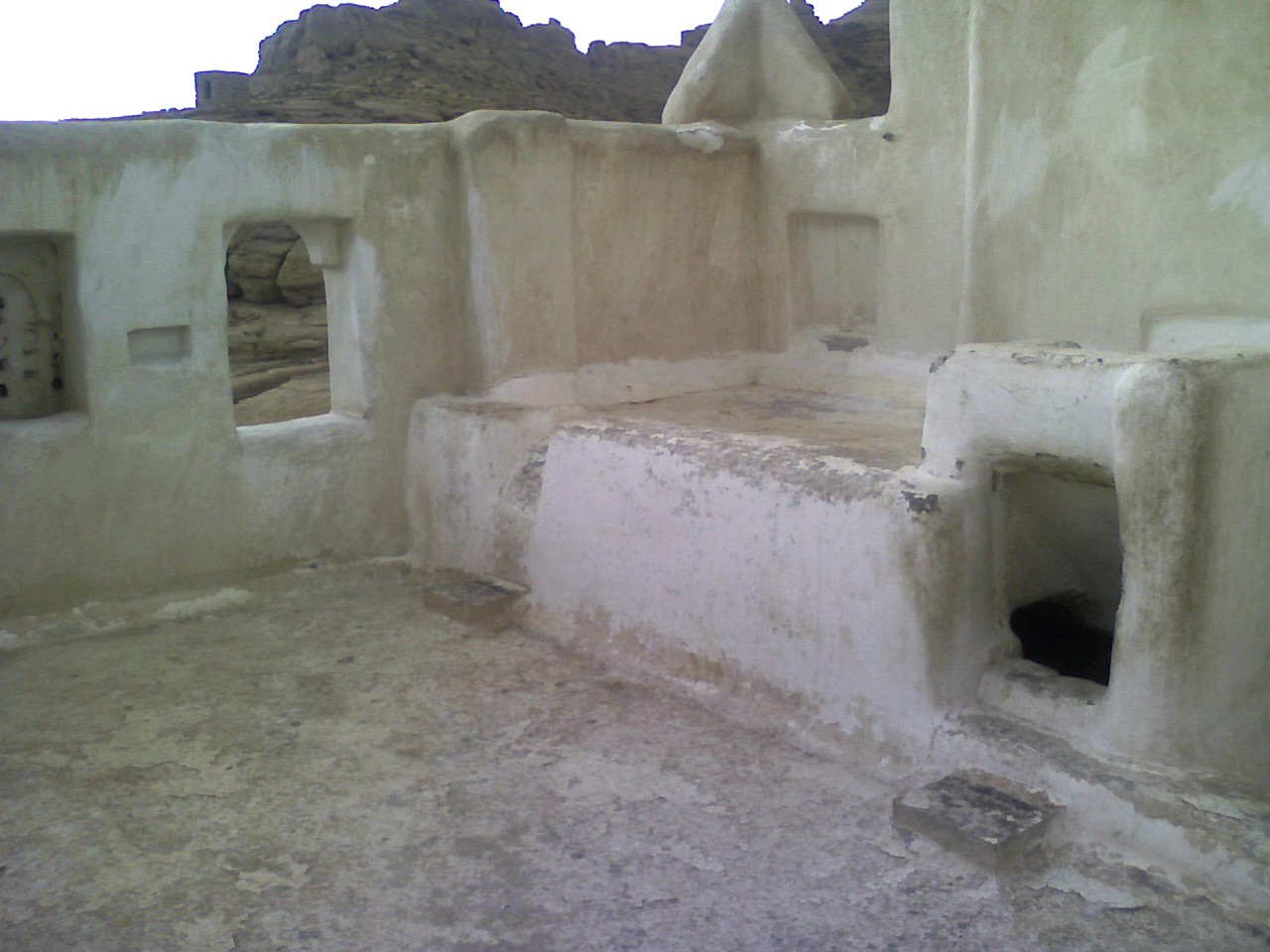 The rampart above the citadel |
Our next stop was the fortress so we piled back into the minibus and began the descent down into the valley. It was an incredibly bumpy road that would have tested the suspension of even the hardiest monster truck and there seemed to be dogs milling around everywhere. We drove down the side of the mountain through a series of tight bends and passed through several forlorn villages, some of which looked like they'd long been abandoned although there did also appear to be farming land here that seemed well tended.
We finally arrived at the fortress which was called Al Hagar that roughly translated as House of Stone. Down here in the valley, we could see the cliff edge from where we had just come and it was immediately obvious that the fortress was positioned relative to the turrets dotted around the mountains that had been strategically placed to make the most of the natural protection that the surrounding cliffs offered. We got out of the minibus and paid the modest entrance fee to enter the fortress grounds.
Straightaway, I bumped my head on a low stone doorway that I had somehow failed to notice. Abdul Hafeed tried not to laugh and led the way inside to a courtyard that had various buildings as well as the fortress itself that towered above us. Everything was well organised and accessible for visitors and we asked a guide to accompany us so we could find out more about the fascinating history behind the whole story of Wadi Dhahr.
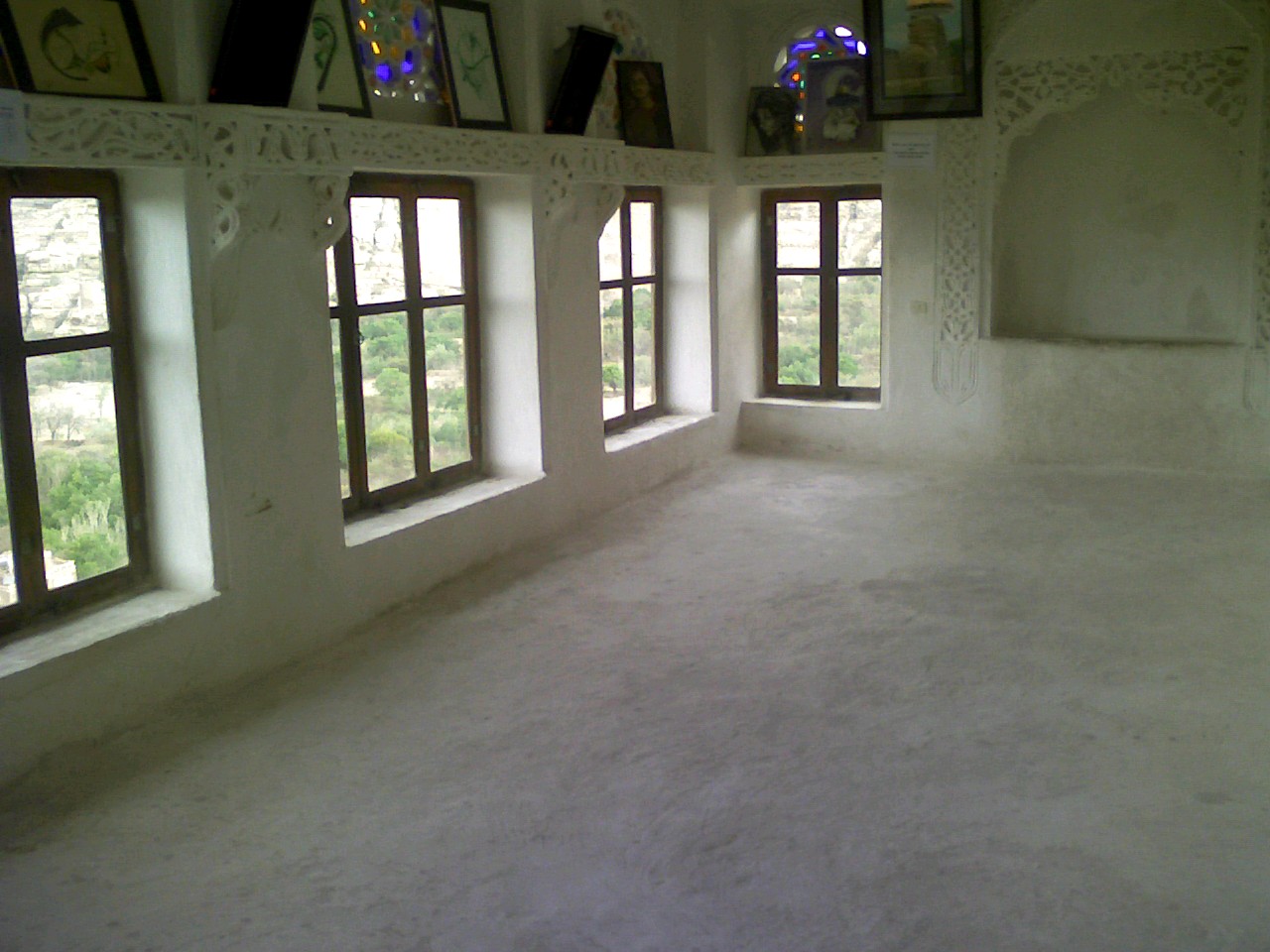 At the top of the fortress is the summer room with many large windows that caught the sun for warmth during the cold winter months |
Phase 1 of the fortress was built in 1860 and consisted of 3 levels built on the stone on which we now stood in the courtyard. These levels pretty much served as the foundations for the fortress with little else to provide any form of protection from enemies. Phase 2 was built from 1860 to 1962 during which period the occupying Ottoman Empire was forced to cede control over to the local tribes. It was during this period that Yemen became known as the Kingdom of Mutawakkiliyah and the ruler at the time, called an Imam although this did not imply any religious connotations, was Yahya Hameed Al Din. He was recognised as a pragmatic down-to-earth leader and was responsible for building the next 3 floors of the fortress, extending the building upwards to where it now stood.
There stood an ancient tree in the courtyard and the guide told us it was from here that Yahya Hameed held court and ruled Yemen from 1917 to 1948. After his death, Yahya Hameed's son Ahmad ruled from 1948 to 1962 and was heavily influenced by the Italians with a more extravagant and modern set of beliefs. At the time, Ahmad had four wives and surrounded himself with Italian "consultants". The fortress was built with a summer house for the kids and children and four winter quarters for each of his four wives, each room facing the sun for heat during the cold winter months.
Exploring the grounds further, we came across two big open rooms that looked out over a series of water fountains into the distance towards the mountains. This is where qat was taken and the long room on the left was where Ahmad sat with whichever wife he had the company of whilst the smaller room on the right is where the other three wives had qat. To the right of this was a smaller maids quarter that included a kitchen. There was also a well and cooling hole where bottles of water would be suspended during the summer heat.
We entered the fortress and began with the first level. This had been built during the conflict so there were lots of secret passages and exit and escape points for the ruler. Some of these passages were quite small and I had to stoop almost to my hands and knees to pass through. Even though Wadi Dhahr had plenty of turrets positioned around the mountains, the ruler still surrounded himself with guards in the fortress such was the fear of attack. To this end, the ruler had his own well to ensure self sufficiency if cut off from the outside whilst the stone used to build the fortress was taken directly from the mountains and was thick and solid to withstand any attacks.
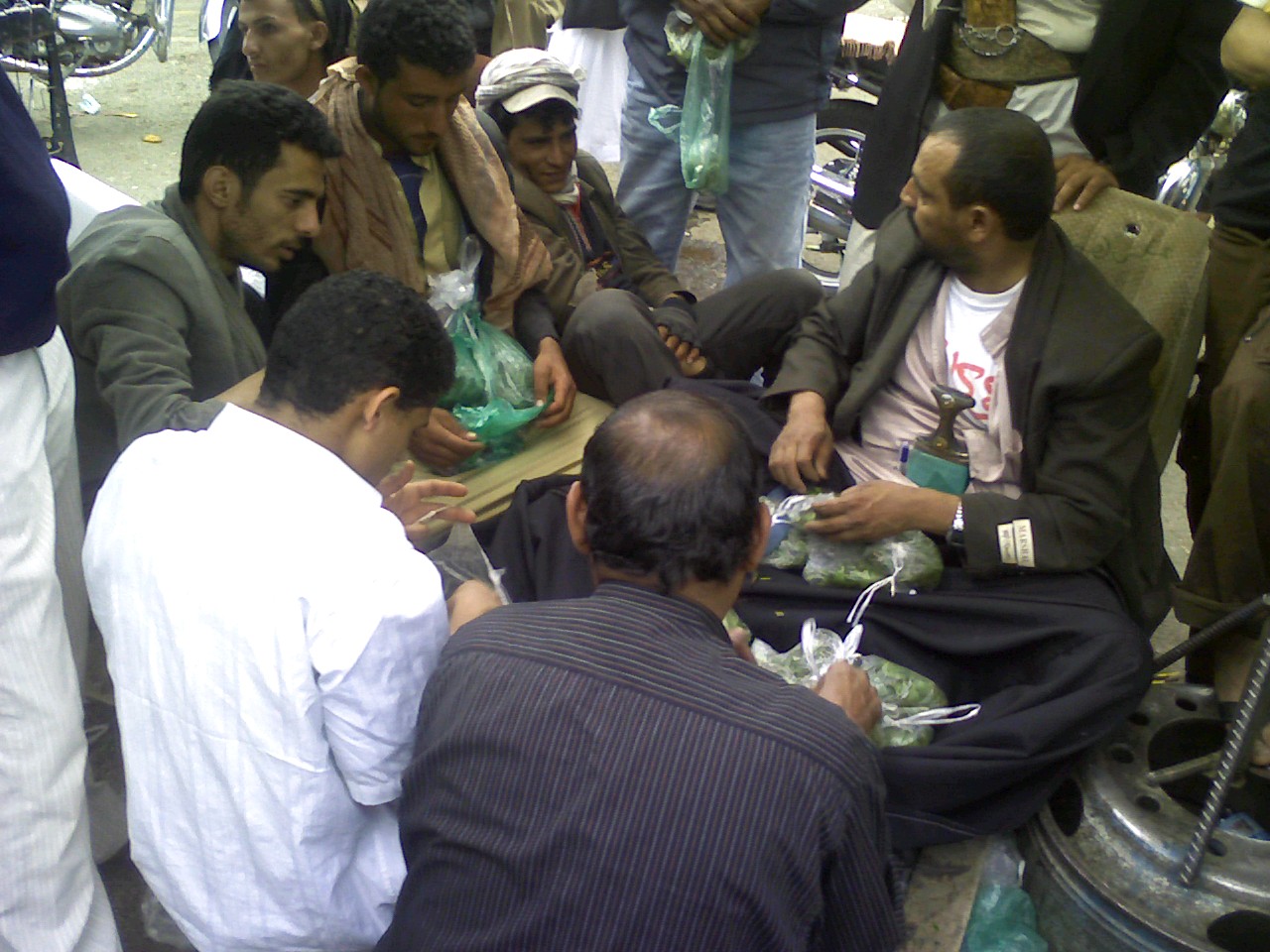 Locals haggling with a qat seller who is carrying his traditional ghambia |
Ahmad ruled through fear and intimidation with threats of beheading for any signs of dissent. He frequently used tales of supernatural powers to test the loyalty of his subjects. One such tale was that Ahmad would tell his people there were ghosts in the town and the only protection was to mark the forehead with soot from smoke when cooking over wood or charcoal. Some people believed their ruler and would duly mark their foreheads with soot whilst others did so out of fear from the consequences if they did not comply. This resulted in pretty much everyone marking their foreheads and Ahmad was thus able to prove to neighbouring Saudi Arabia that he was a big shot with the total loyalty of all his subjects.
The obedience and submission of the local tribes was key to ensuring anyone was able to maintain rule in Yemen. To this end, Ahmad took a boy from each tribe. These hostages were then taken to a fortress called Al Salah in a place called Ta'izz, about 255km south of Sana'a, where they were brought up conditioned and brainwashed to be loyal to Ahmad and to also ensure the loyalty of their respective tribes. Once again, the ruler would use ghost stories to instil fear into the boys.
Ahmad would tell them that a ghost would leave his body and command each boy as to what to do. He would then record his voice onto discs and put them into a box forcing the boys to obey. One boy challenged the ruler saying if you have a ghost then why hide it in a box, why don't you show it instead but this was quickly slapped down with a threat of beheading if the boys' respective tribes were not loyal.
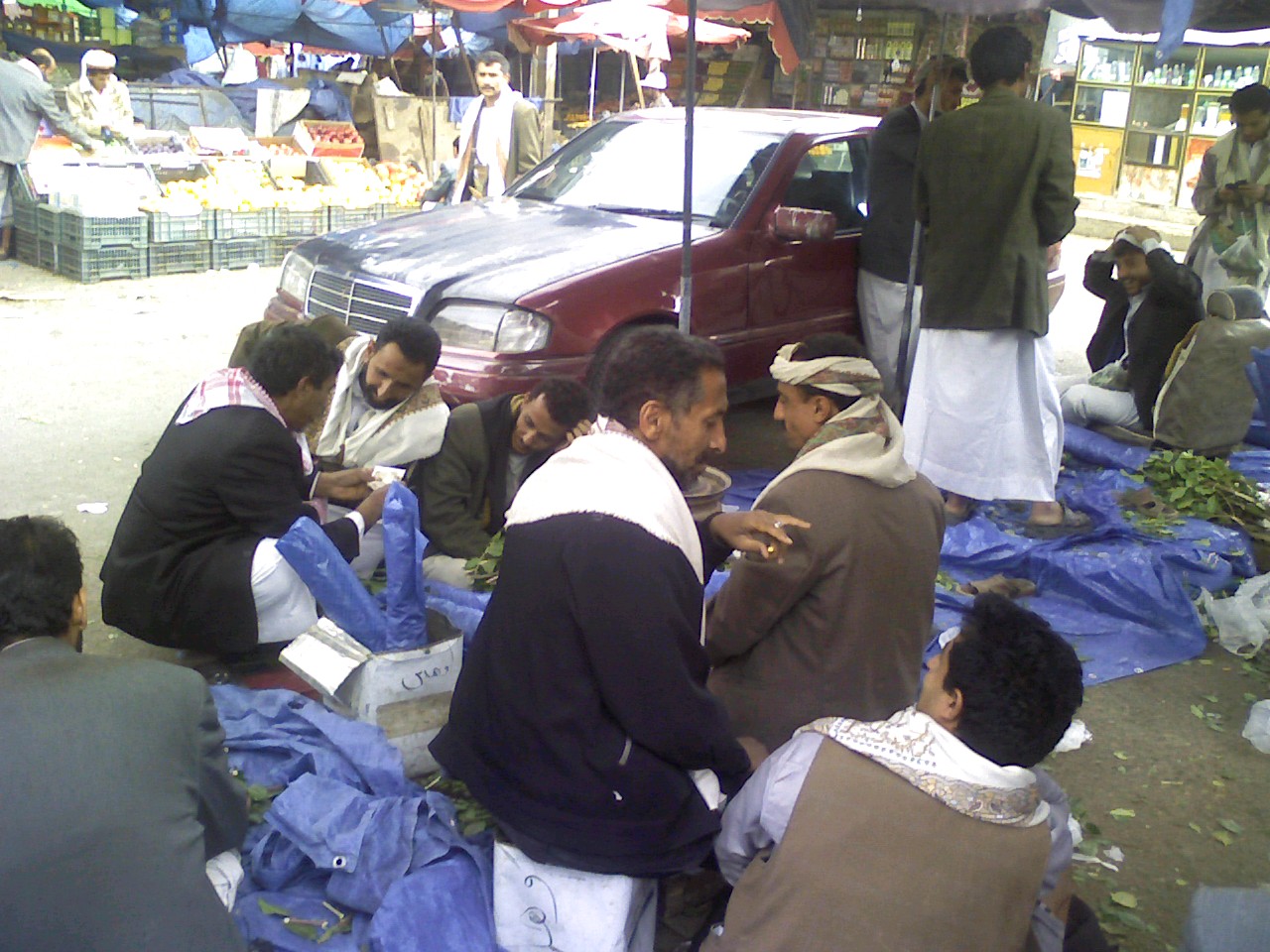 Traders set up a pitch to sell qat in whatever free spot they can find in the qat market |
History is usually dictated by the victors and the official historical account records that Ahmad died of natural causes. Our guide however related a very different account that seemed far more accurate in keeping with the character of Ahmad as a tyrant who ruled through fear. It was whilst visiting Hudayda that Ahmad was shot and killed by a man called Al Olufi. However, a group of people loyal to Ahmad put out the word that the ruler hadn't died and Olufi, scared of his consequences and terrified of retribution, committed suicide by shooting himself.
Ahmad's eldest son was Al Badr who assumed rule of Yemen after his father died. However, the revolution occurred one week after Al Badr took rule in 1962 and he fled to Saudi Arabia taking gold and silver. Saudi Arabia and also Jordan are both kingdoms that believe in the hereditary principle of rulership and so backed Al Badr with support to fight the revolution. Joined by Ahmad's brother Al Hassan, both Al Badr and his uncle aimed to stablish a base in Yemen to fight the revolutionists but gave up after several years and settled with just taking money from their Saudi hosts.
Saudi Arabia had always wanted Yemen to be a kingdom because the Saudi's believed in absolute rule and were forever poking their nose into other country's business when it suited them best. Even to this day, Saudi Arabia continues to interfere in other Gulf country's affairs and has been critical about the recent elections in Iraq. By supporting Al Badr financially and politically, both Jordan and Saudi Arabia thought they could buy his loyalty and thus total obedience together with the compliance of the local tribes. However, when Saudi Arabia officially recognised the Republic of Yemen in 1970, Al Badr left in disgust to exile in the UK where he died in 1996 and was subsequently buried.
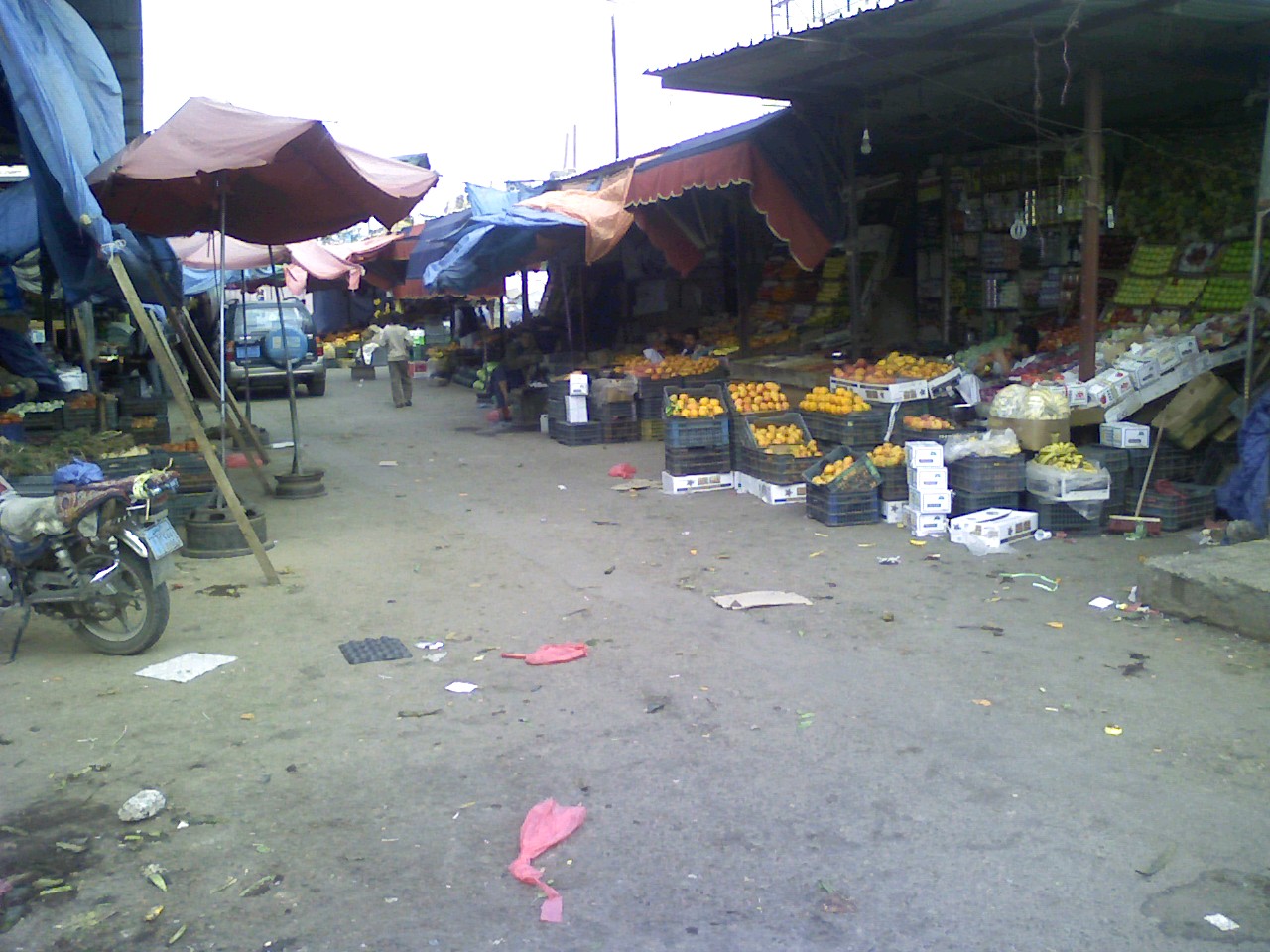 A quiet period in the qat market |
We spent a good few hours at Wadi Dahr exploring as much of the ground as possible; not only was it rich in history but it also offered wonderful views across the valley and beyond. There were a few other visitors present as well but we pretty much had the entire place to ourselves.
The guide was extremely helpful and knowledgeable with ready answers for all our questions whilst remaining discrete so we could wander around at leisure. We gave him a healthy tip upon leaving and were surprised by a sudden downpour that began just as we headed back to the minibus. I was soaked within minutes and the roads began to fill up with huge puddles of water that Abdul Hafeed swerved to avoid.
The way back to central Sana'a seemed far longer than when we came and I soon nodded off in the comfy minibus as my clothes dried under the sun that had peeped out from behind the rain clouds. I awoke just as we entered Sana'a again and Abdul Hafeed parked up outside the main qat market. Hussain and I got out to go with Abdul Hafeed and have a look around.
The market was pretty big and had stalls outside whilst inside it was filled exclusively with men despite qat being popular with both Yemeni men and women. Most of the trader's seemed to be fairly old guys and they were selling qat from stalls, out of the back of cars, on rugs spread on the floor and even from paper bags stuffed in coat pockets. At each place, a crowd of men would gather to inspect the leaves and then barter furiously.
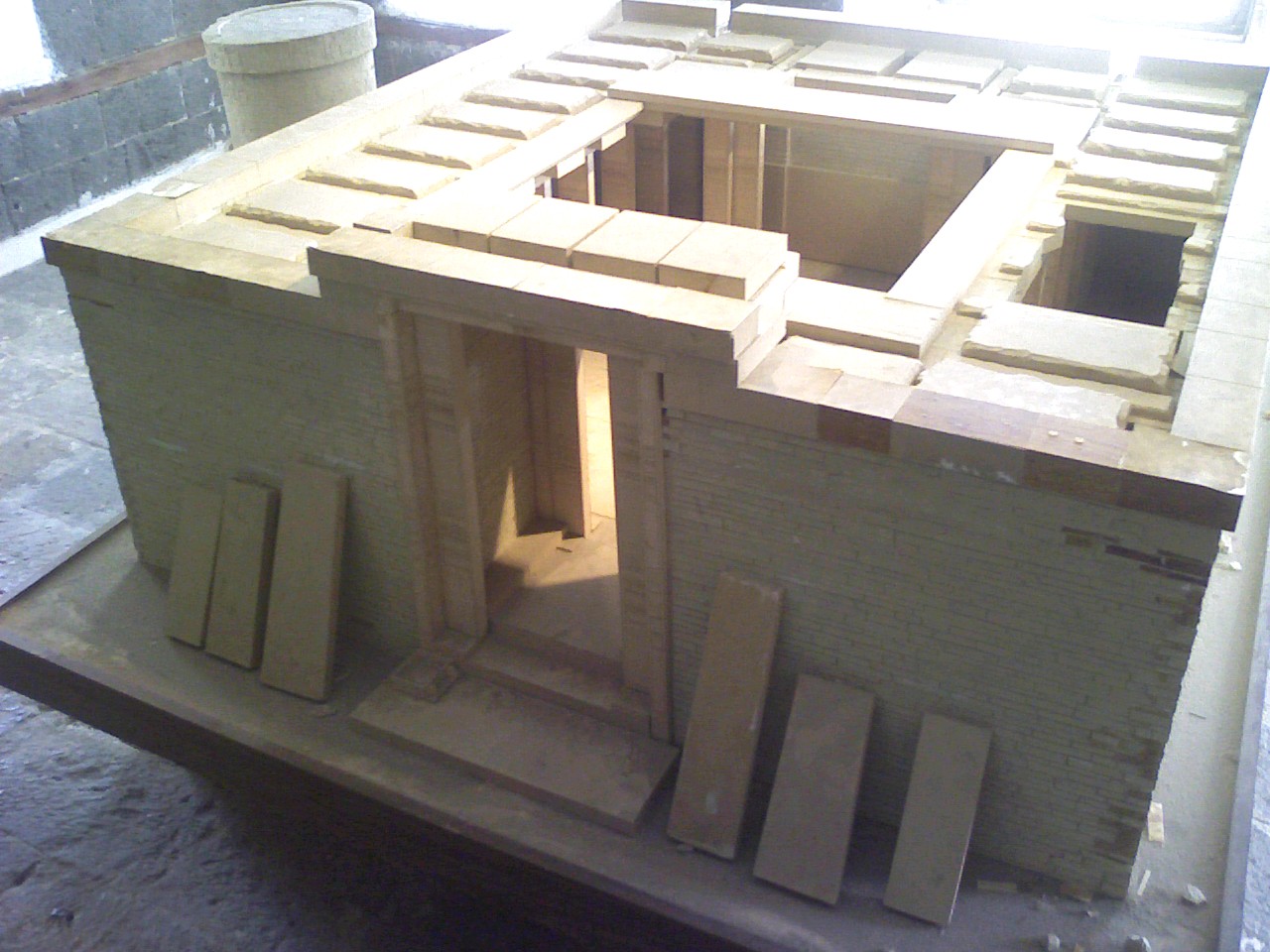 A model of the ancient Yemeni temples |
To me, the plants all looked the same; long green stalks with leaves that looked similar to something between spinach and coriander. However, Abdul Hafeed told us qat was priced so that everyone could afford it and the quality and properties of the leaves differed widely as well as the selling pitch. Hence, the qat sold outside of the market from the back of cars tended to be the expensive stuff whilst it was cheaper inside which is why it was more crowded and busy. Similarly, one could usually tell the quality of the qat from the bulge in the cheek. A huge bulge like if the person had a couple of golf balls in his mouth indicated that the qat was lower quality as more leaves were required to provide the stimulus whereas a small bulge like a gobstopper would mean the good stuff as fewer leaves were needed.
There even seemed to be an etiquette as to the correct side on which to chew qat. For men, the custom was to chew on the right side but for women it could be either cheek. However, I did see men with both cheeks bulging and also with qat on their left side so it appeared that as long as the qat was good, however or wherever you chweed it didn't matter as much.
We left the market and headed back to the apartment for dinner. Howida had cooked a rice dish called kabsa and had prepared two types, one with lamb and the other with large cuts of chicken and potato that was very similar to the meal we had in Saudi. Accompanying this was something Howida called burake, a particular speciality of Sana'a, which was a delicious meat pie filled with cheese and vegetables (mainly coriander) and diagonally cut before serving.
The bint al sahen today was made with thicker layers of pastry than yesterday but with far less honey so it tasted a bit more savoury. Our meal over, it was time to try the qat Abdul Hafeed had bought earlier. Qat has to be taken on a full stomach and most Yemeni's usually starting chewing it after lunch for pretty much the rest of the day. Now that Abdul Hafeed mentioned it, I couldn't recall seeing anyone having qat during the morning.
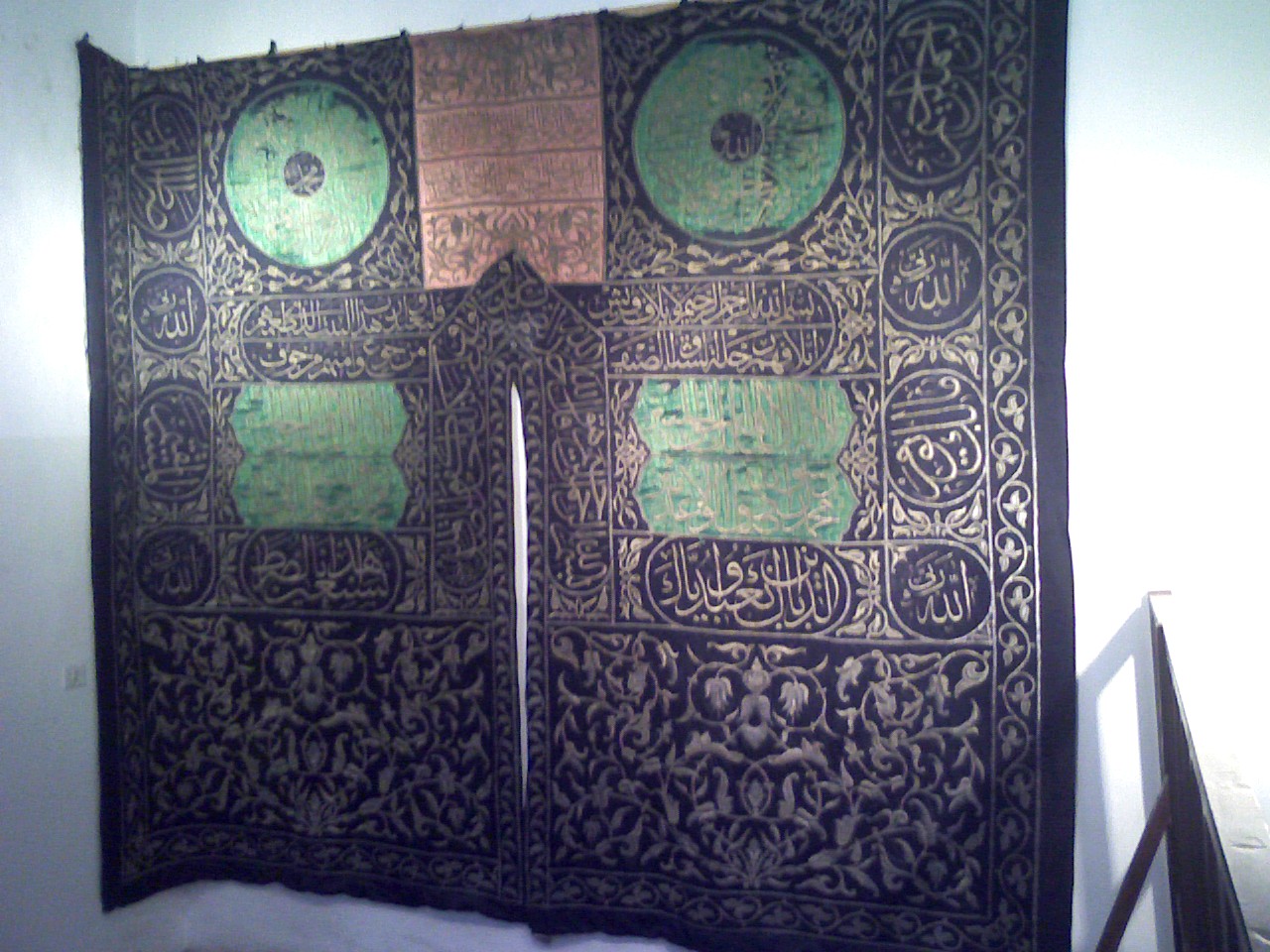 Cloth that covered the holy Ka'aba |
The actual way to take qat was to tear off the leaves from the stalks and chew them a few at a time until there was enough to give the desired stimulus. I had no idea what to expect and tentatively popped a few leaves into my mouth. It tasted awful and was very bitter but with Abdul Hafeed watching and Hussain urging me on, I crammed in a few more leaves and chewed them for a few minutes before shifting the storage to the rapidly growing bulge in my cheek.
The leaves just sat in my mouth and the bitterness soon caused me to start salivating like a rapid dog. I was constantly swallowing the water that made me feel even more ill although Yemeni's would spit if outside. After thirty minutes, I couldn't take it any more and whispered to JD that I had to get rid of the qat and rinse my mouth before I threw up. JD who had also been apprehensive about taking the qat agreed and we went to the bathroom to empty the bulge in our cheeks and rinse.
It was a relief to wash out the bitter taste and although the effects of good qat were said to kick in within ten minutes or so, neither of us felt energised or anymore "wired" than usual. As with any local custom, we'd tried it but it wasn't for us and we didn't take it again on our trip.
We sat for a while chatting and the conversation turned to reading tea leaves. To my surprise, Howida casually mentioned that Abdul Hafeed was quite the skilled reader of tea leaves and would be willing to read ours once we finished our cups. Hussain was the first one and left the room with Abdul Hafeed as the readings were not done in front of everyone and could involve discussions that were private.
JD and I were up next and went together as JD would need to translate what Abdul Hafeed was saying. I needed to drink the last of my tea leaving only a little water inside and then turn the cup down on the saucer and give it to our host. Abdul Hafeed lifted the cup and examined it closely inside for a good five minutes before starting. Using the tip of a pen, he then pointed out the various shapes and objects that seemed to materialise from the tea leaves and began providing a breakdown of what it all meant.
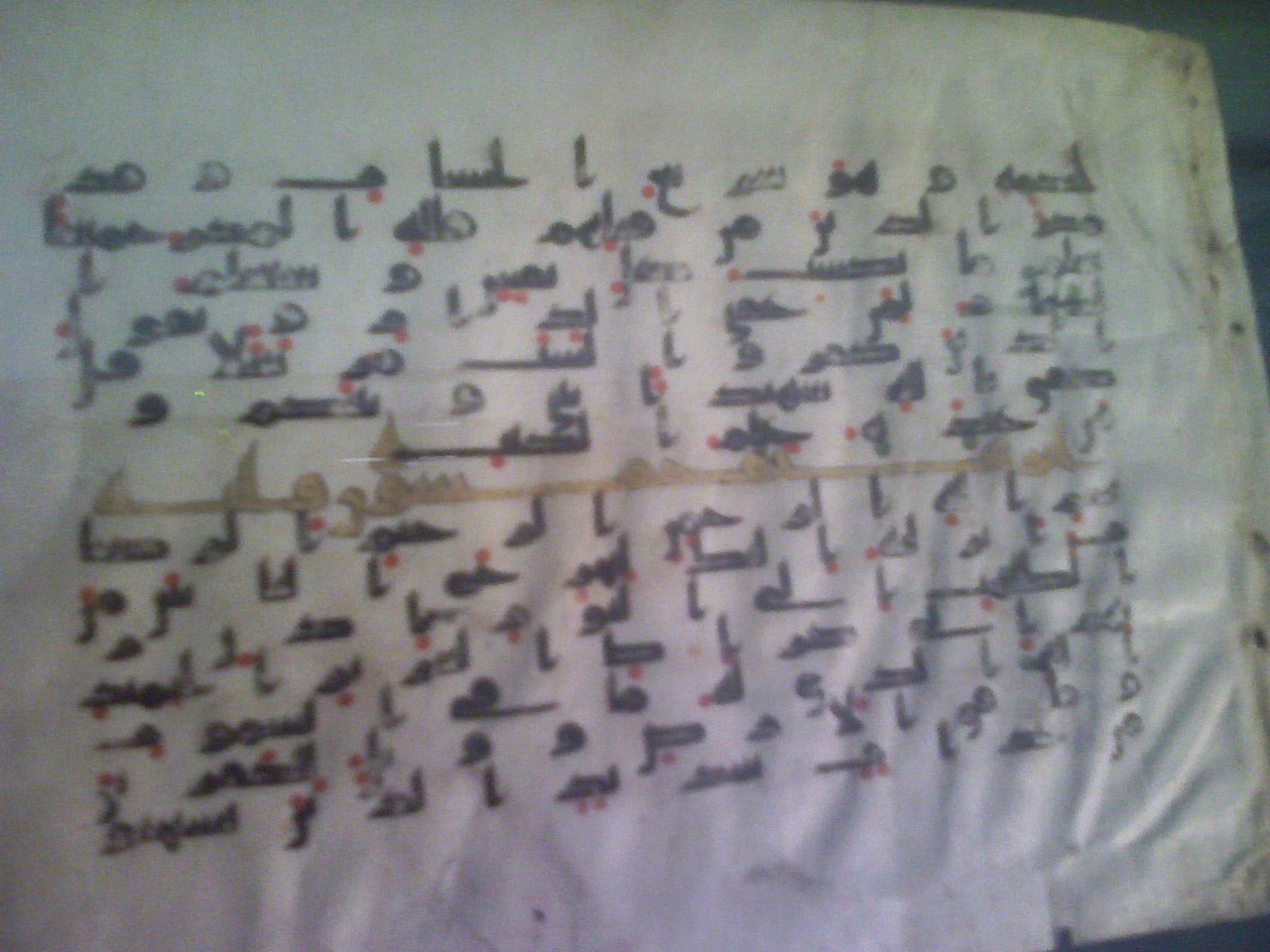 A page from the world's oldest known copy of the Quran |
It was fascinating stuff, all done in fun of course as Islam frowns upon any form of fortune telling that is taken seriously, and what I particularly liked is that Abdul Hafeed took his time and actually pointed out what he could see and where there were specific shapes rather than just merely giving the narrative. With my tea cup done, it was JD's turn and I left the room to give them privacy although JD would be sure to share the details later on.
After everyone had finished, there was a sudden power cut and the whole neighbourhood plunged into darkness. Apparently, this was a fairly common event and Howida's place was well equipped with a collection of cosy lamps and candles. We lit a few in the lounge and sat by the dreamy flames that flickered into life whenever Howida laughed. The group was in high spirits swapping tales and poking fun at each other whilst the younger kids were excited at having been allowed to stay up until well past their bedtime. It was rather like sitting around a campfire telling stories and made me realise just how unnecessary a TV was for entertainment.
The power was restored forty minutes later and we got up to leave. Once again, the streets were absolutely silent, totally devoid of any person or vehicle and we sped through the empty roads to arrive at our hotel in no time at all.
Monday 29 March 2010
We were up early to visit the National Museum in Sana'a. This was located in the centre of the capital a short distance away from our hotel and looked rather like an old palace surrounded by thick walls, the type that you might find guarding a castle. Set in a large open courtyard and arranged across several floors, it was a splendid old building full of historical artefacts from the ancient kingdoms of Yemen. As the museum was only open until 12 noon we hurried around to see as much as we could and ended up staying until nearly 1pm which didn't go down too well with the officials there. We had a guide with us who seemed more interested in giving us the shortest possible answer so he could lock up the museum and go home as quickly as possible but he duly followed us around and gave commentary on the various exhibitions.
 Video clip of the National Museum Video clip of the National Museumand surrounding buildings |
During our visit, the museum had focused the displays around three specific ancient dynasties, all of which pre-dated Islam. These were, in chronological order from the 8th century BC, the Kingdom of Sa'ba (also known as Sheba), the Kingdom of Ma'in and the Kingdom of Himyar which dated from the 2nd century BC. Each exhibition was thoughtfully arranged with detailed descriptions written in both Arabic and English along with references to other nearby displays. As the museum was empty, we pretty much had the whole place to ourselves and could wander around at will meaning that we managed to see everything albeit rather hurriedly.
There was a section about each capital city for the ancient kingdoms with Ma'reb being the capital of Sa'ba, Barakesh for Ma'in and Dhafar for Himyar. Our guide told us an interesting story about Barakesh. The temple here was heavily defended against the Greeks who only managed to capture it when they heard a dog barking inside and went around the walls to see where the noise was coming from. The Greeks subsequently found a well that led inside from which they invaded the temple.
The religion of the South Arabian kingdoms during this period was a polytheistic one with a pantheon presided over by an astral triad of the Moon God, known as Ilmaqah in Sa'ba, the Sun Goddess Dhat Himyam, and the Morning Star God Athtar. The temples of the gods were usually the finest buildings in any town since they symbolised the wealth of the community and were often rectangular in plan, roofed and with at least one raised altar. Some of the temples were open-air but with a surrounding perimeter wall and the most famous was the Temple of Awam in Ma'reb which belonged to Balqis, more commonly known as the Queen of Sheba. This massive temple had an oval perimeter wall and a grand peristyle court with 32 large, square, monolithic pillars. Pilgrims flocked to this temple from far and wide dedicating many offerings and votive objects to the god.
The museum also housed what is widely believed to be the world's oldest known copy of the Quran. This was written with dark brown ink on parchment using foliated Kufic script with diacritical marks indicated in small red roundels. On the lower part was the Sura of Prophet Ibrahim with a heading written in gold. Another copy of the Quran was very similar in style but written instead using the Mashq script that was less angular and had no diacritical marks. Along with the ancient Quran manuscripts, there was also a cloth on display that had once covered the Ka'aba in Makkah thousands of years ago.
 Video clip from Tahrir Square of Video clip from Tahrir Square ofthe surrounding area |
With the officials following us around and locking up the doors to the rooms that we had visited to encourage us to leave, we took the hint and stepped back out into the courtyard. I would have liked to stay longer but with only a day left of our visit, we had a schedule for the afternoon. There was a war fort near to the museum that was originally built by the Ottomans and had been expanded by Ruler Ahmed that I would have liked to have seen too but this was also closed.
Our next stop was Tahrir Square, just away a short walk from the National Museum. Tahrir is the Arabic word for freedom and this was "Liberation Square" where the 1962 revolution started. It was also the centre of modern Sana'a and served as a point of reference for directions as it was so well known. Tahrir Square was a bustling area with plenty going on and I had a wander around whilst Abdul Hafeed ran some errands.
A group of school kids were playing an energetic game of football barefoot. Despite the square being paved over, the boys were not afraid to lunge for the ball and I saw several of the lads go in with sliding tackles without any regard for personal injury or torn trousers. The energy of the game was impressive along with the fact that an imprompt game of football could take place in such a central location without anyone batting an eyelid. Could you imagine the fuss this would cause if anyone tried the same in Trafalgar Square?
 Video clip of football in Tahrir Square Video clip of football in Tahrir Square
|
It was a lovely hot day without any humidity and a group of women strolled past with ice creams that suddenly seemed to be a great idea. I was just about to head over to the nearest cold store when Abdul Hafeed turned up and not wishing to cause any fuss, I followed him back to the minibus.
We drove out of Tahrir Square and headed past the old Parliament that was crowded outside with tribal guards wearing civilian clothes. Qatar had built the new Parliament building but the old one was still used and a session was apparently being held today.
Right outside our hotel was the friendship bridge called Al Sadaqa that was built several years ago by the Chinese government. The bridge spanned a vast graveyard located a short distance away from the centre of the capital. When the bridge was being built, the authorities said that whoever wanted to exhume bodies for reburial could do so otherwise the flyover would be built on the tomb. The story goes that some of the bodies of very pious people that were dug up showed no signs decomposition.
The graveyard was called Khuzaymah and plots here started from 100,000 Yemeni Rials. The going rate for plots inside the city was 50-60,000 Rials whereas outside the city would have cost even less at 20,000 rials. The reason for the high price at Khuzaymah was down to the central location that was easy to get to as well as a general shortage of land on which to build in Sana'a. Additionally, Khuzaymah was well looked after and considered a prestigious place in which to be interred.
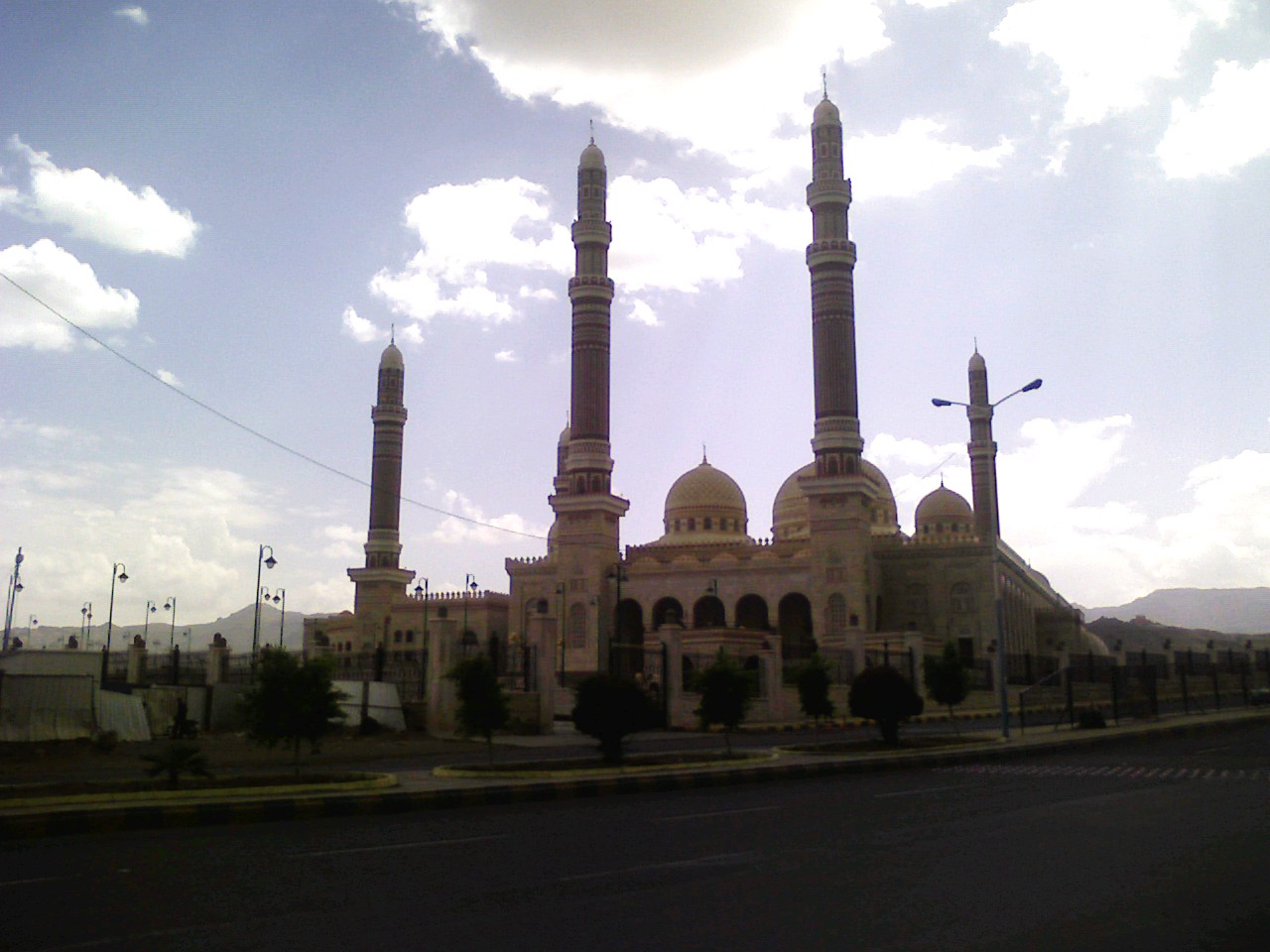 The magnificent Al Saleh mosque |
We drove past one of the seven gates of Sana'a. This was Bab-al Yaman, the North Gate and the most important one that led to the famous salt market that dated back to the kingdom of the ancient dynasties. Traditionally, the salt sold here came from the rivers of Ma'reb, around 250km south of Sana'a. The market was still active today and people came from all over to buy salt here as the quality was very good and it was all naturally derived from minerals using methods passed down the centuries.
We had a wander around the old salt market called Souq al Maleh that was steeped in history and located in the centre of old Sana'a. Abdul Hafeed told us a little more about the customs and traditions here whereby women were always addressed by their husbands name rather than their own. In Yemeni culture, a woman's name was a very personal thing and something to be shared with family only hence why the husbands name was used to address any females. The salt market also used to have a gems auction that was called samasera where even people used to be auctioned in the olden days.
Driving out of Sana'a, we headed up a long straight highway and passed Maydan Al Sabaeen which means Seventy Stadium. Military parades took place here and the stadium was so named because Al Badr ruled for just a single week before the revolution took place and then spent the next seven years trying to reclaim Yemen. The loyalists subsequently surrounded the presidential palace for seventy days before giving up after realising they could not invade.
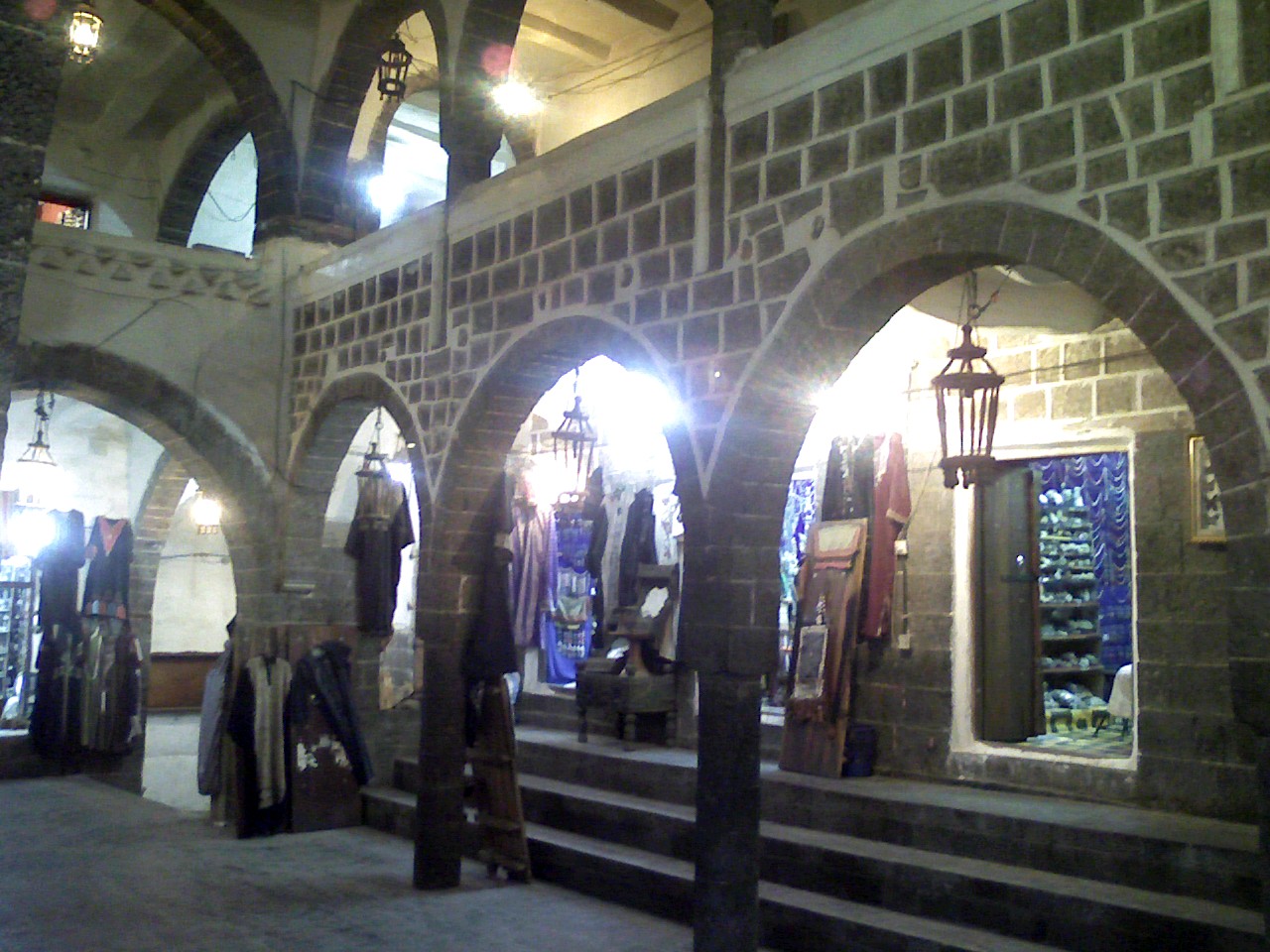 A row of traditional shops in a small indoor souk in the old part of San'a |
Right next to Maydan al Sabeen was the magnificent Al Saleh mosque with its six minarets. This is a truly stunning building that manages to combine traditional Islamic architecture with subtle cues from Yemen's vast and rich heritage of ancient kingdoms. It was a cloudy day with rain showers when we visited and even then it looked nothing less than utterly majestic rising out of the relatively flat landscape and immediately drawing the eye from near or far.
Right behind the mosque was the Presidential Palace that looked huge but circled by a high wall and manned by soldiers who looked as though they wouldn't think twice about opening fire. These were the Republican Guards who surrounded the palace and were elite soldiers rather than just the regular military. Houses near the palace could not be built higher than a single storey and the Yemeni President prayed in a section of the Al Saleh mosque with bullet proof glass after an assassination attempt in 2000. Indeed, such was the paranoia of such further attempts on his life, the President had built a direct tunnel between the palace and the mosque just to avoid being seen and caught out in the open.
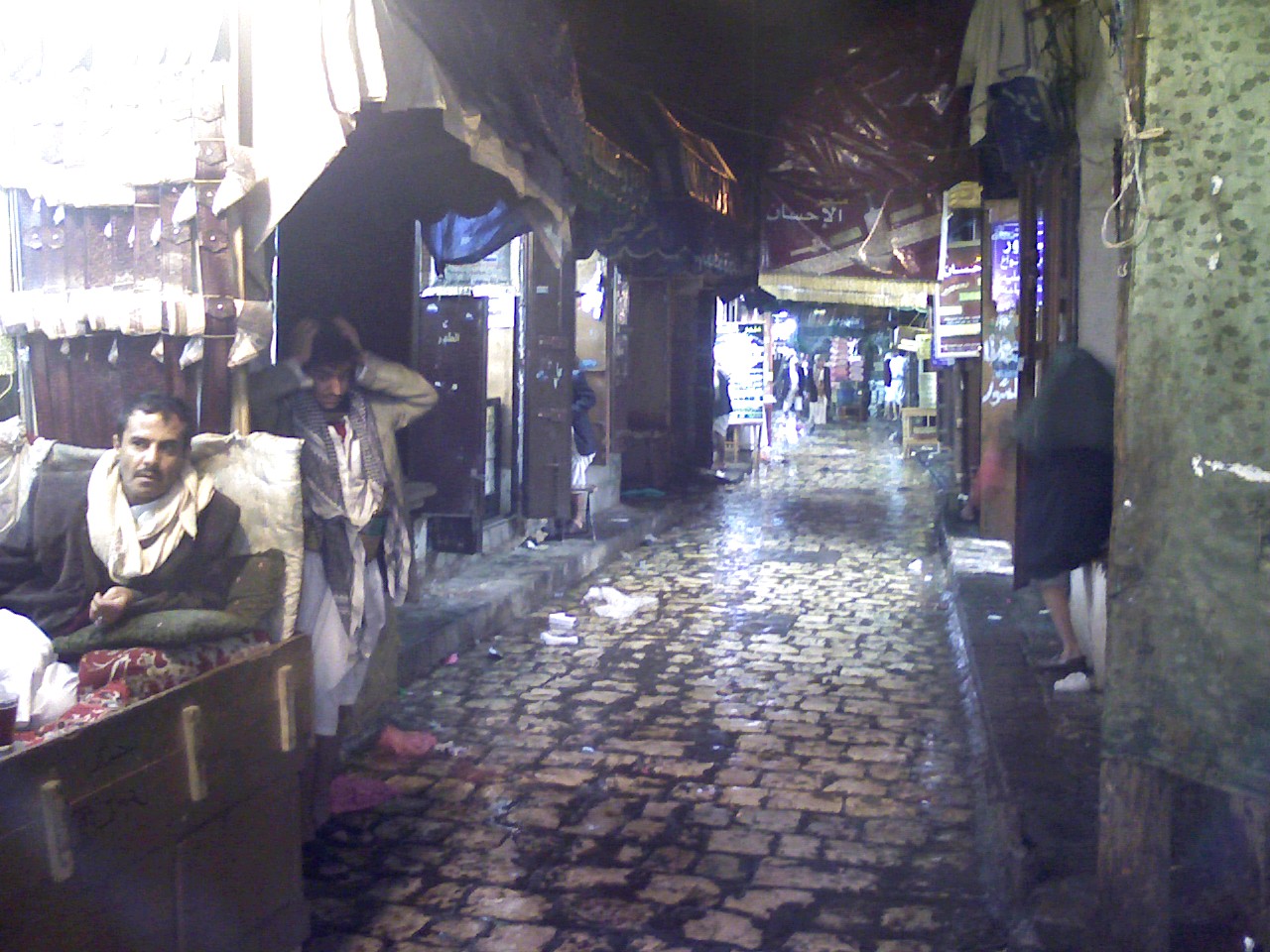 The narrow alleys in old San'a market quickly empty during a sudden downpour |
The chicken was nice and chunky but the fries were rubbish and the coleslaw far too sweet. About par for KFC then which consistently manages the wholly undesirable feat of selling cardboard fries at pretty much all its restaurants regardless of which country they are in.
It had been raining heavily all afternoon and continued into the evening when we drove back down to Souk Al Maleh. Despite the weather, the climate was fresh and pleasant although the downpour had left huge puddles everywhere that had to be jumped or skirted. Parking up outside the main entrance, we got out and entered the market through one of the gates. It was fairly crowded and there was water everywhere but little traffic as the roads were very narrow and cobbled with barely enough space for a car to drive through.
The rain suddenly intensified and we hurriedly took refuge under one of the many market stalls that had a canopy but not before everyone had got a good soaking. JD suddenly felt compelled to start singing in the rain as the temperature back home was still hitting the high 40's. There was something strangely comforting about standing there wet through under the tarpaulin watching the sheets of water pour down and I too at that moment felt the urge to sing with JD.The rain died long enough for us to carry on and I caught the exciting aroma of many exotic spices as we entered the food section. Despite this being the spice market, it was actually quite large and sold pretty much everything with the stalls all grouped together by wares. It was impossible to walk past a table without having a nosy at some of the brightly coloured spices on offer and there was plenty here that I didn't even recognise. However, we carried on and eventually came to our destination right in the middle of the market.
 Video clip of a rainy Souk al Maleh Video clip of a rainy Souk al Maleh
|
Here was an old mosque built by the local people in remembrance of where Imam Ali gave a speech during the third year of Hijri. The speech was to introduce Islam to this particular area, Yemen having already accepted it earlier. The place were the Imam stood to give the speech is called Al Masmura al Manghura and it is here that any disputes are resolved. It is said that bad things happen to people who break promises or renege on a deal struck at Al Masmura al Manghura.
Whilst we had been wandering around the spice market, it suddenly occurred to me that there had been quite a few teenage boys following us. They didn't approach and merely walked a few paces behind as if they belonged to our group. Howida told us that they were simply curious as I wasn't dressed like a local so it was obvious I wasn't from around here. After a few minutes, they would wander off again once they had decided that there actually wasn't anything special to see and lo and behold, after fifteen minutes, our audience departed and we were left on our own again.
The other thing that struck me whilst walking in the market was that there were few Indian and Pakistanis in Yemen, something very unusual given that people from the Indian subcontinent are very common among other Gulf countries and often made up the majority. However, the reasons were soon clear as to why. Yemen is a poor country like much of the Indian subcontinent therefore the earning potential is considerably less than other places in the Middle East. It makes no sense for an Indian or Pakistani to come to Yemen to earn money when they wouldn't be able to make much more than they would in their homeland. Also, Yemen has plenty of locals willing to take low paid jobs mainly those traditionally taken by economic migrants.
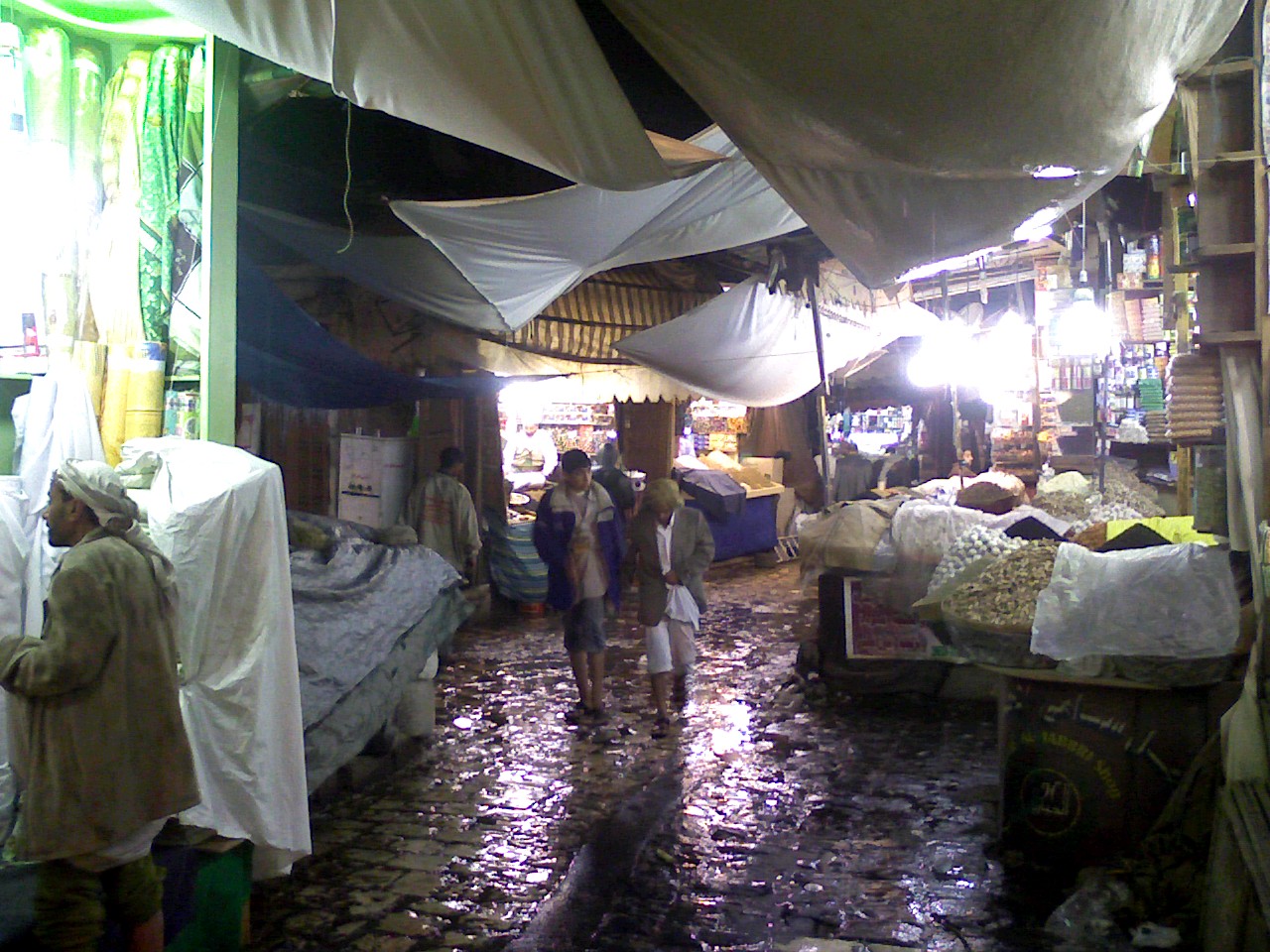 The intoxicating spice market |
Abdul Hafeed had gone to get a couple of umbrellas and appeared just as we were heading back to the minibus. This was our last night in Yemen and both JD and I felt that we really needed a few more days as there was plenty that we hadn't yet managed to see in this most historic of cities.
Driving out of Sana'a once more, we stopped at a large clothes outlet that seemed to sell everything very cheaply indeed. As the poorest country in the Middle East, JD told me that a lot of people from around the Gulf would actually make the effort to come to Yemen purely to buy cheap goods, especially clothes that are horrendously expensive pretty much anywhere in the GCC.
Leaving the outlet and driving up a steep and winding mountain road, our final place for the night and indeed the trip was to Asser to see two monuments that had been erected here by the Chinese and Egyptians. The Chinese built the first road from Sana's to Hudayda and their monument was in tribute to all the Chinese workers who died during this period.
The Egyptian monument was built in honour of those Egyptian soldiers who supported the revolution and stayed for several years in Yemen after the revolution began. The soldiers were sent by the Egyptian president Abdel Nasser to bolster the basic Yemen army who were didn't number many nor were adequately equipped to defend against the loyalists.
Unfortunately it was far too dark to see either monument clearly and with midnight approaching, there was nothing to do but turn round and head back down into Sana'a. However, driving back down the mountain road, the clouds parted and we were treated to the lovely sight of seeing the capital spread out beneath us like a canvas and lit up in all its glory as if it was Eid. This was a perfect way to end our trip and we parked up on one of the roads overlooking Sana'a to enjoy the view one last time.
There wasn't much to pack but we needed to be up early to check out and settle the hotel bill plus we had had an early start that day so we asked Abdul Hafeed to drop us back at the hotel to give our gracious hosts some much needed rest too.
Tuesday 30 March 2010
We packed and checked out of the hotel. This was our last day in Yemen and we had decided to have breakfast with Howida at the apartment so Abdul Hafeed came to pick us up shortly after 9am. Driving over to Howida's, Abdul Hafeed told us about the traffic laws in Yemen. Apparently, insurance for private cars was not required. If you were hit from behind, whoever bumped into you had to pay the full costs of any damage and repairs. However, if your car was hit on either side, you were responsible for paying a third of the bill whilst the person who hit you would have to settle the other two thirds. Police were not involved in traffic accidents unless the parties couldn't agree on who hit whom. However, if the police did get involved, this was a long process that went through the courts so people usually decided between themselves.
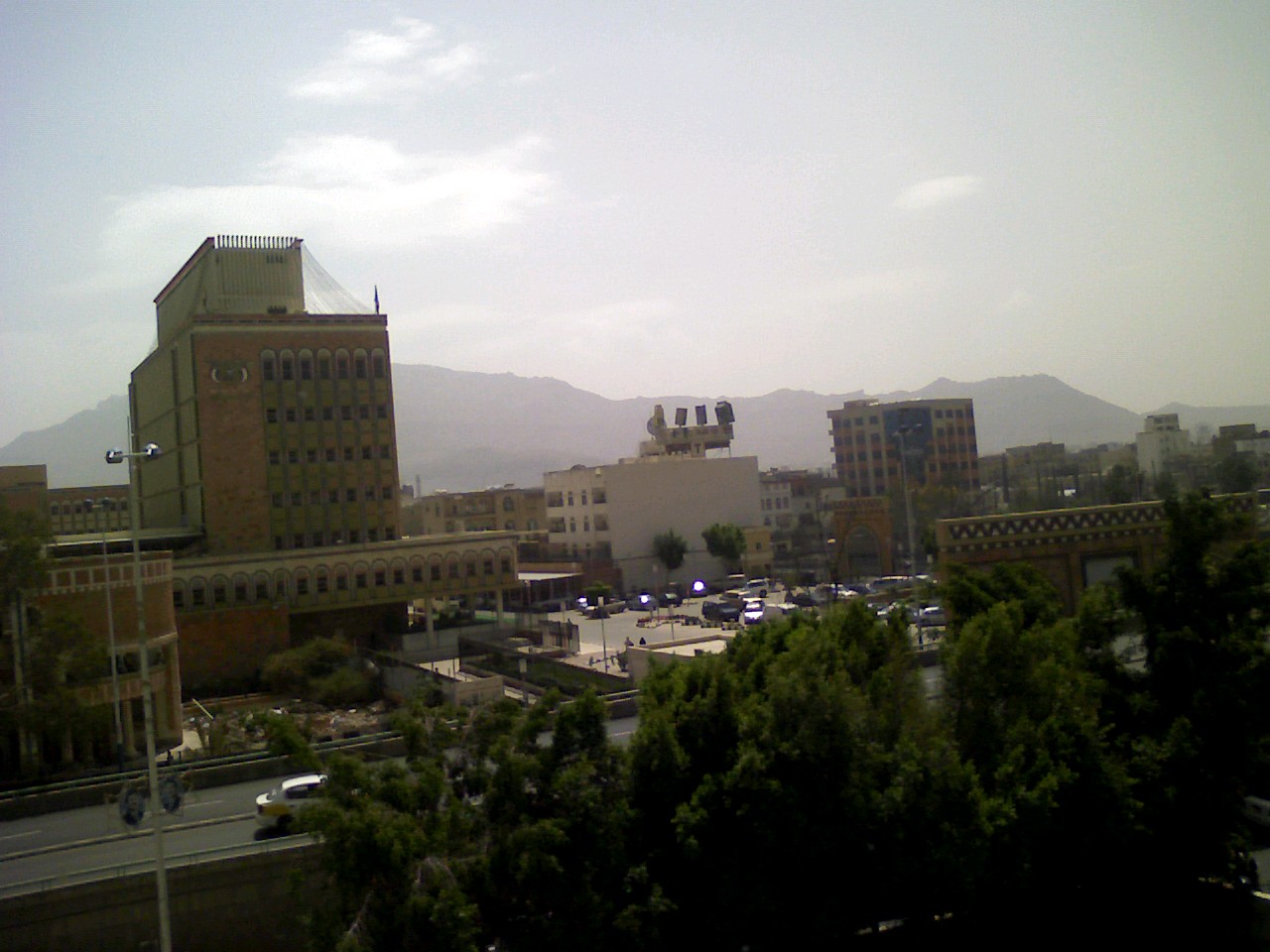 View from the Sheba hotel of the Central Bank with surrounding mountains |
Taxis were the only insured cars on the road with the payout limited to USD $50 per driver or USD $200 covering whichever car they hit. All drivers had to wear seatbelts (but not the passengers) otherwise it was a 10,000 Yemeni Rial fine. Because of poverty, the police would often take a cash bribe to wave any fines by asking the driver whether they would rather pay the government 10,000 or the police officer 5,000. The official driving age in Yemen is eighteen but teens could get any Governmental ID card and then offer a bribe to the traffic department to get their licence. In short, Yemen was no different from anywhere else in the Gulf where bribery and wasta could get you pretty much anything you wanted.
At Howida's we had a traditional Arabic breakfast that was delicious soft flatbread with cheese and olives. There was a fresh kiwi for afterwards that was so sweet that I finished the whole lot. With an afternoon flight, we didn't stay very long and everyone piled into the minibus one last time to see us off at the airport. The route there was slightly different from when we came and we passed through what looked like a more modern part of Sana'a with car dealerships and contemporary housing.
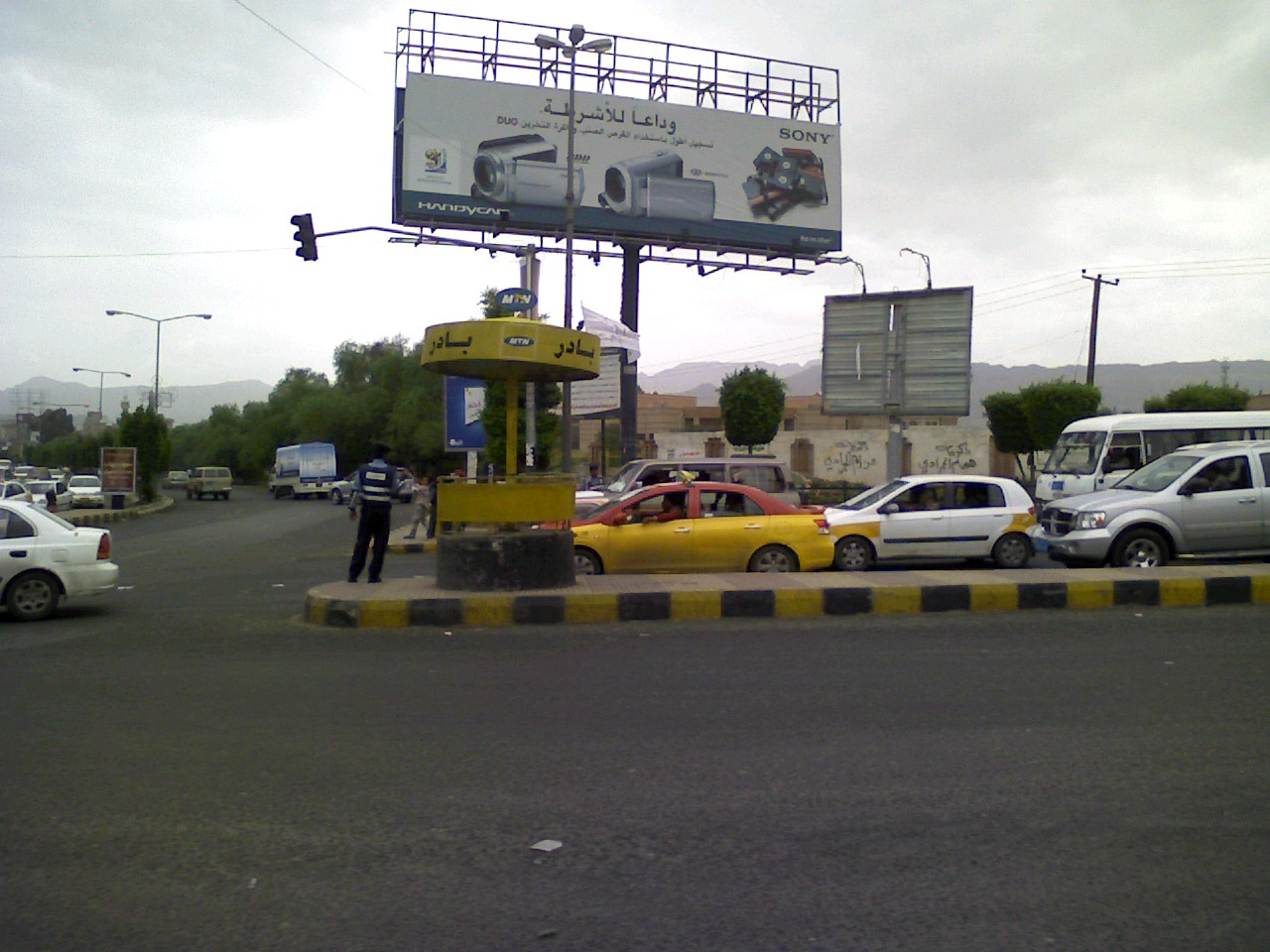 A Yemeni traffic officer on duty |
Back on the highway, we passed Al Rawdah and arrived at the airport. "We won't miss you because you haven't stayed long enough", was Howida's typically sarcastic but warm farewell. Shaking hands with Abdul Hafeed, he said to me in Arabic, "you came as a friend but you're leaving as my brother" and then gave me a bear hug, ever the gentleman and most gracious of hosts.
With Hussain staying on for a few days in Yemen, it was up to JD to do all the talking and we entered the airport that had a few armed soldiers mooching around the door. Non-travellers were not allowed inside which I thought a bit strange. There was no queue at the check-in desk and with a last wave to Howida who had stayed at the door to ensure there were no problems, we headed to the departure area. Security was heavy with every case and item of luggage checked twice in the x-ray machine whilst both JD and I were searched thoroughly. Armed guards were everywhere but security wasn't cumbersome and everything seemed quick and efficient so we were done within a matter of minutes.
The airport was similar to the one in Taif but much smaller and with just two gates. There were no departure boards but there was a duty free that sold goods which would have been cutting edge thirty years ago. There were video tapes, cassettes, old style Sony Walkmans and lots of perfume. There was never going to be any premium brands here given the disposable income of most travellers but there were certainly plenty of fakes. It was possible to buy Mont Blanc pens, Rolex watches and even designer handbags, all of which were poor quality imitations.
With nothing to do, JD and I sat at the back of the seating area and watched our fellow passengers fill up the departure gate. At length, two flights were called, both very similar to each other and there was a mad rush followed by confusion as people swapped places to ensure they were on the same flight. Once again, a bus took us to the waiting aircraft and we boarded and got our final glimpse of Yemen as the plane took off. Just as there had been when we first arrived, there were still lush green fields, dramatic swirls of yellow and brown and faraway mountains to remind us that no matter what else happened in this part of the world, the Yemeni landscape would pretty much remain the same as it had been for thousands of years.